IntroductionUrinary incontinence (UI) and pelvic organ prolapse (POP) are pelvic floor disorders frequently associated due to their shared pathophysiology and risk factors.
1,2 Tissue weakening, combined with increased intra-abdominal pressure, can lead to various types of prolapse, whereas weakening of the urethrovesical junction and urethral sphincter deficiency can result in stress urinary incontinence (SUI).
3,4 It has been estimated that women have approximately a 1 in 4 lifetime risk of developing pelvic floor disorders.
5 These disorders are more prevalent in older women and have become increasingly common in clinical practice due to population aging.
5 Urinary incontinence symptoms and their impact on quality of life are highly subjective. To objectively quantify the symptoms, several validated questionnaires are available, including the International Consultation on Incontinence Questionnaire - Short Form (ICIQ-UI-SF).
6,7Surgical correction of POP can be performed via different approaches, with the technique choice depending on the site requiring correction, the presence of concomitant defects, patient body type, clinical conditions, and the patient's desire to maintain sexual activity. In cases of UI, surgical treatment is indicated for the stress subtype when an anatomical defect is associated with symptoms.
5 The most commonly performed surgery for SUI is the midurethral sling with synthetic mesh. Although midurethral slings remain an established treatment option for SUI, concerns regarding mesh-related complications have shaped patient counselling and regulatory discussions. Importantly, the April 2019 FDA action ordered manufacturers to stop selling and distributing surgical mesh products intended for transvaginal repair of pelvic organ prolapse; midurethral slings for SUI were not included in that order and remained available.
8Given the strong association between the disorders, the possibility of treating both POP and SUI during the same surgical procedure has been questioned. This issue has led to other studies, which have demonstrated improvement in urinary incontinence symptoms with pelvic organ prolapse correction alone.
9,10 Beyond that, the surgical risks increase with the simultaneous performance of a mid-urethral sling and POP correction, including bladder perforation, urinary tract infections, greater bleeding, and incomplete bladder emptying within six weeks postoperatively.
11 Some authors advocate performing POP correction alone and subsequently deciding on the need for additional UI treatment, which minimizes unnecessary procedures, reducing surgical risks and associated complications.
12,13There is a lack of consensus in the literature regarding the simultaneous correction of both conditions, whether in cases of pre-diagnosed UI or occult urinary incontinence (OUI) due to prolapse.
14 Three surgical approaches that address both pelvic floor disorders have been described: correcting the prolapse while simultaneously performing preventive SUI surgery, correcting the prolapse and evaluating UI symptoms postoperatively to determine the need for further surgery, or conducting preoperative testing for OUI, ensuring both procedures are performed only in selected patients. Combining the two procedures during the same surgery increases the chances of procedural morbidity and may not provide clear benefits to the patient, especially because postoperative outcomes cannot always be predicted. Moreover, the current debate about synthetic mesh use in SUI treatment necessitates a thorough discussion about performing both procedures concomitantly.
This study aims to evaluate urinary incontinence symptoms following POP surgical correction, comparing ICIQ-UI-SF scores before and six months after the procedure. Our hypothesis is that significant improvement in UI symptoms occurs in the patients, avoiding unnecessary procedures with higher surgical risks.
MethodsA prospective observational cohort study was performed. Between May 2022 and July 2024, eligible patients from the urogynecology outpatient clinic were invited to participate in this study during their regular consultations. This study was reported according to the STROBE statement for observational studies and the project was approved by the Research Ethics Committee of the
Hospital de Clínicas de Porto Alegre, Brazil, under approval number 5.263.737, dated February 25, 2022 (
Certificado de Apresentação de Apreciação Ética – CAAE Nº. 54494921.7.0000.5327), and was conducted in accordance with the principles of the Declaration of Helsinki. Before data collection, patients consented to participate by signing an informed consent form that explained the study procedures and stated that patients could withdraw from the consent at any time during follow-up. It was also clarified that the proposed treatment would be provided regardless of their participation in the study.
Patients who had symptoms and physical examination findings consistent with POP, for whom surgery was indicated, and who also had a clinical diagnosis of urinary incontinence were selected. All POP surgeries were performed by the urogynecology team at the hospital, composed of three gynecologic surgeons with extensive experience in pelvic floor reconstructive procedures.
Exclusion criteria included patients who had undergone prior surgical treatment for POP or UI, those who corrected only the posterior compartment, patients with prior pelvic radiotherapy, those undergoing any surgical procedure for UI concomitant with POP correction, and those with known neurological pathology.
Urinary incontinence (UI) and its subtypes were defined according to the International Continence Society (ICS) and International Urogynecological Association (IUGA) terminology. Classification was based on clinical history and physical examination obtained during routine urogynecology consultations. Stress urinary incontinence (SUI) was defined as involuntary leakage on effort, exertion, sneezing, or coughing. Urgency urinary incontinence (UUI) was defined as involuntary leakage accompanied by or immediately preceded by urgency. Mixed urinary incontinence (MUI) was diagnosed when patients reported symptoms consistent with both SUI and UUI.
Urodynamic testing was not required for inclusion in the study and was performed only in selected cases as part of standard clinical care when diagnostic uncertainty was present. Therefore, the UI subtypes presented in Table 1 represent symptom- and examination-based clinical diagnoses.
All patients completed the ICIQ–UI-SF questionnaire preoperatively and at three and six months postoperatively.
Follow-up assessments were scheduled preoperatively and at 3 and 6 months after surgery. Minor variations in sample size across time points resulted from missing questionnaires at specific visits. Missing data were handled using a complete-case approach for each assessment: patients with unavailable ICIQ-UI-SF scores at a given time point were excluded from analyses involving that visit. No imputation procedures were performed. These discrepancies are reported in the tables for transparency.
Patients underwent one of four predefined prolapse repair approaches: anterior colporrhaphy (AC), anterior and posterior colporrhaphy (AC+PC), AC combined with vaginal hysterectomy (AC+VH), or AC+PC+VH. These subgroups were described to document the distribution of surgical techniques; however, because several groups contained very small numbers of patients, the study was not powered for between-group statistical comparisons. Accordingly, subgroup analyses are presented descriptively, without inferential testing.
The severity of urinary incontinence symptoms was assessed using the ICIQ-UI-SF scale. The International Consultation on Incontinence Questionnaire - Short Form (ICIQ-UI-SF) consists of four items that yield a score assessing the frequency, severity, and impact of urinary incontinence on quality of life. Due to its brevity, the ICIQ-UI-SF is notable for its rapid application, facilitating its use. This questionnaire categorizes symptom severity into four groups: slight (scores 1–5), moderate (scores 6–12), severe (scores 13–18), and very severe (scores 19–21).
7 For outcome interpretation, cure or continence was operationally defined as an ICIQ-UI-SF score of 0, corresponding to the asymptomatic category. The combined outcome "continent or with slight symptoms" was defined as an ICIQ-UI-SF score from 0 to 5.
The sample size was calculated to detect whether the within-patient mean difference in ICIQ-UI-SF scores over time was greater than zero, with a mean difference of 4.8 units considered clinically relevant for the study. The PSS Health online tool (version 14) was used.
15 Considering 80% power, a one-sided 2.5% significance level for sample-size planning based on the directional hypothesis of postoperative improvement, and an expected standard deviation of 9.2 units for the within-patient difference, the total sample size required was 31 pairs. Adding 10% for potential losses and refusals, the calculated sample size was at least 35 pairs. Although, the sample-size calculation was based on a one-sided directional hypothesis, the final statistical analyses were reported using two-sided 95% confidence intervals and a significance level of
p<0.05.
The R programming language (version 4.1.0, R Core Team. R: A language and environment for statistical computing) was used to process and analyze the data. Before analysis, quantitative variables were assessed for distribution. Due to asymmetry, they were expressed as medians and interquartile ranges. Categorical variables were expressed as absolute and relative frequencies. Complete case analysis was performed, and missing data cases were excluded from the analysis.
Generalized estimating equations (GEE) with identity link and Gaussian distribution were used to model repeated ICIQ-UI-SF scores over time, assuming an unstructured working correlation matrix to avoid imposing restrictions on correlations between time points. The final model included time as the main explanatory variable, and the β estimates represent mean differences in ICIQ-UI-SF scores over time. Exploratory multivariable GEE models including age, BMI, POP-Q stage, UI subtype, and surgical type were considered; however, these variables were not retained because of the small sample size, sparse subgroups, and absence of meaningful improvement in model performance. Medians and interquartile ranges were used only for descriptive summaries because the score distribution was asymmetric. Robust sandwich standard errors were applied to support statistical inference from the Gaussian working model and reduce dependence on strict distributional assumptions. Residual-versus-fitted and quantile–quantile plots were visually inspected, and no major deviations compromising the adequacy of the Gaussian GEE specification were observed. A pseudo-R
2 was calculated as 1 − (model deviance/null deviance) to provide an approximate overall measure of explanatory capacity. For final statistical inference, two-sided 95% confidence intervals and a significance level of
p<0.05 were used.
ResultsDuring the study period, 40 patients met the inclusion criteria. Participant flow is shown in Figure 1. One patient withdrew from surgery, leaving 39 patients who underwent surgery and composed the surgical safety population for complication assessment. Two operated patients were excluded from the ICIQ-UI-SF outcome analysis: one was diagnosed with urethral carcinoma requiring an alternative surgical treatment, and one underwent a concurrent procedure for UI (Kelly-Kennedy paraurethral plication). Thus, the analytic cohort for ICIQ-UI-SF outcomes included 37 patients.
The median age of the patients was 64 years [interquartile range (IQR): 58–70 years]. Thirty-four patients (92%) had had two or more pregnancies, and 33 (89%) two or more vaginal deliveries. Most patients were non-smokers (92%), did not have diabetes mellitus (89%), and did not have chronic obstructive pulmonary disease (COPD) (97%). The median body mass index (BMI) was 26.2 kg/m
2 [IQR: 25.0–29.3 kg/m
2]. Among patients with available UI-subtype classification (n=36), 72.2% had mixed urinary incontinence (MUI), 16.7% urgency urinary incontinence (UUI), and 11.1% stress urinary incontinence (SUI) (Table 1).
Regarding to POP, 16% of the patients had stage II, 68% stage III, and 16% stage IV (Table 1). All surgeries were performed vaginally, four patients underwent anterior colporrhaphy alone, four underwent both anterior and posterior colporrhaphy, fifteen underwent anterior colporrhaphy combined with vaginal hysterectomy, and fourteen underwent anterior and posterior colporrhaphy combined with vaginal hysterectomy. Table 2 presents the median ICIQ-UI-SF scores at the preoperative stage, and at 3 and 6 months following pelvic organ prolapse surgery, according to the type of procedure performed.
The median preoperative ICIQ-UI-SF score was 15 points [IQR: 12–18 points]. Three months postoperatively, the score decreased to 4 points [IQR: 0–10 points], and at six months, to 3 points [IQR: 0–7 points] (Table 3).
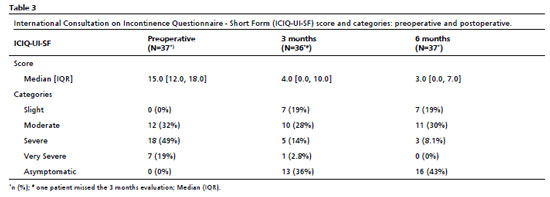
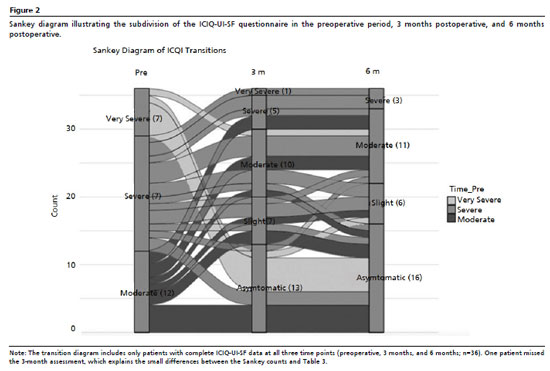
Preoperatively, no patients had slight symptoms; 12 (32%) had moderate symptoms, 18 (49%) severe symptoms, and 7 (19%) very severe symptoms. At three months of postoperative follow-up, 13 (36%) patients were asymptomatic, 7 (19%) had slight symptoms, 10 (28%) moderate symptoms, 5 (14%) severe symptoms, and 1 (2.8%) very severe symptoms. At six months, 16 (43%) patients were asymptomatic, 7 (19%) had slight symptoms, 11 (30%) moderate symptoms, 3 (8.1%) severe symptoms, and none had very severe symptoms (Table 3). The results are also illustrated in the Sankey diagram (Figure 2), which demonstrates the ICIQ-UI-SF symptom categories and their progression over six months, highlighting a reduction in the severe and very severe symptom groups and an increase in the asymptomatic and slight symptoms groups.
Complications were assessed in the surgical safety population, defined as all women who underwent surgery after the consent to participate in the study (N=39). This denominator differs from the analytic ICIQ-UI-SF cohort (N=37), because two operated patients were excluded from the urinary incontinence outcome analysis: one was diagnosed with urethral carcinoma requiring alternative surgical treatment, and one underwent a concomitant procedure for urinary incontinence. Among the 39 operated patients, one patient experienced an intraoperative bladder injury (1/39, 2.6%) and required indwelling catheterization for 8 days. Eight patients developed lower urinary tract infections (8/39, 20.5%): five in the immediate postoperative period (5/39, 12.8%), two at three months (2/39, 5.1%), and one at six months postoperatively (1/39, 2.6%). Four patients were treated for bacterial vaginosis (4/39, 10.3%). One patient required cauterization of a vaginal cuff granuloma (1/39, 2.6%).
In the GEE model, the estimated mean reduction in ICIQ-UI-SF score was 9 points at three months [95% confidence interval (CI): -11 to -6.8;
p<0.001] and 10 points at six months [95%CI= -12 to -8.3;
p<0.001].
The model showed a deviance-based pseudo-R
2 of 0.45, which was used only as an approximate measure of model fit and should not be interpreted as the proportion of variance explained in the usual linear-regression sense. Together with the statistically significant time coefficients, this result supports an association between postoperative follow-up time and reduction in ICIQ-UI-SF scores (Table 4).
DiscussionThis study aimed to quantify urinary incontinence (UI) symptoms in symptomatic patients undergoing surgery for pelvic organ prolapse (POP) correction using the ICIQ-UI-SF questionnaire scores at three and six months of follow-up. Patients demonstrated lower ICIQ-UI-SF scores during postoperative follow-up, with a 10-point mean reduction at six months, and more than half of the patients were asymptomatic or had only slight UI symptoms after POP correction without additional UI procedures.
Our results align with previous studies and support the strategy that UI symptoms improve following POP surgical correction alone. An observational study in Denmark involving 1,657 women showed over 70% of patients experienced symptom improvement or complete continence, regardless of the UI subtype, after POP correction.
9 A national Finnish study reported a 35% cure rate for stress urinary incontinence (SUI) and a 14% improvement in symptoms over two years of follow-up after POP correction, with symptom severity reducing across all corrected prolapse compartments.
13 Regarding detrusor overactivity, Muñoz et al. observed statistically significant reductions in urgency, frequency, and incontinence symptoms one year after POP correction.
10 Similarly, a Brazilian study by Lourenço et al. reported a 52% reduction in overactive bladder symptoms following POP correction.
16 In this study, 43% of the patients were asymptomatic, and an additional 19% had slight symptoms at six months, according to the ICIQ-UI-SF categories. Therefore, our findings were consistent with the literature. These data support the hypothesis that a significant proportion of women with UI requiring surgery for POP correction may experience UI symptom improvement solely via POP correction.
Factors related to postoperative UI symptoms after POP correction, such as COPD and elevated BMI (body mass index), are associated with persistent SUI symptoms.
17 In contrast, more advanced prolapse stages (III and IV) appear to be associated with a higher likelihood of UI improvement after correction.
9,12 In our study, we could not demonstrate characteristics associated with postoperative outcomes; only the time following POP correction was linked to symptom improvement. This limitation is primarily due to the sample size and the homogeneity of the cohort. Most patients had mixed urinary incontinence (MUI), stage III prolapse and underwent similar surgical procedures - anterior colporrhaphy combined with vaginal hysterectomy. Consequently, we cannot conclude patients with isolated SUI achieve similar outcomes, given these patients are most indicated for UI surgery.
The current trend is toward greater caution and shared decision-making when considering SUI surgery concomitant with POP correction, particularly because of concerns regarding mesh-related complications. Regulatory actions and guidance should, however, be interpreted according to the specific indication. In the United States, the April 2019 FDA order applied to surgical mesh intended for transvaginal POP repair and did not include midurethral slings for SUI.
8 In the United Kingdom, NICE guidance recommends careful counselling when concurrent surgery for SUI and POP is considered, including discussion of uncertainty regarding effectiveness beyond one year and the risk of complications compared with sequential surgery.
18 This context supports individualized decision-making rather than a general restriction on midurethral slings for SUI.
An alternative to synthetic materials is the use of autologous fascial slings. While these achieve similar outcomes, they involve longer surgical times and require dissection of the rectus abdominis fascia or fascia lata. Our findings, consistent with the literature, provide additional support for recommending initial POP correction surgery, followed by an evaluation of the need for additional SUI treatment. This approach minimizes overlapping procedures and associated surgical risks.
These results have important implications for clinical practice in managing POP associated with UI - two prevalent conditions in gynecological care. In this cohort, patients undergoing POP surgery showed a decrease in UI symptoms after prolapse repair alone, supporting the hypothesis that POP correction first, followed by reassessment of the need for additional UI treatment, may be appropriate for selected patients. However, our single-arm observational design limits causal inference, as changes in symptoms may also reflect natural variability or postoperative behavioral adjustments. In addition, the six-month follow-up period was relatively short and does not allow conclusions regarding the long-term durability of urinary incontinence outcomes. The small sample size further restricts subgroup analyses and the identification of independent predictors. Future research, ideally involving controlled or randomized designs, is needed to confirm these findings and to better identify patient characteristics, UI subtypes, and POP stages associated with the most favorable outcomes.
References1. Rogers RG, Pauls RN, Thakar R, Morin M, Kuhn A, Petri E, et al. An international Urogynecological association (IUGA)/international continence society (ICS) joint report on the terminology for the assessment of sexual health of women with pelvic floor dysfunction. Int Urogynecol J. 2018; 29 (5): 647-66. doi: 10.1007/s00192-018-3603-
2. Kenne KA, Wendt L, Brooks Jackson J. Prevalence of pelvic floor disorders in adult women being seen in a primary care setting and associated risk factors. Sci Rep. 2022; 12 (1): 9878. doi: 10.1038/s41598-022-13501-w
3. Fitri AN, Kurniawati EM, Wiyasihati SI, Wungu CDK. Risk factors of stress urinary incontinence in pelvic organ prolapse patients: a systematic review and meta-analysis. Afr J Urol. 2023; 29 (1): 53. doi:
https://doi.org/10.1186/s12301-023-00383-14. Bai SW, Jeon MJ, Kim JY, Chung KA, Kim SK, Park KH. Relationship between stress urinary incontinence and pelvic organ prolapse. Int Urogynecol J Pelvic Floor Dysfunct. 2002; 13 (4): 256-60; discussion 60.
5. Good MM, Solomon ER. Pelvic Floor Disorders. Obstet Gynecol Clin North Am. 2019; 46 (3): 527-40. doi: 10.1016/j.ogc.2019.04.010
6. Lone F, Thakar R, Sultan AH. One-year prospective comparison of vaginal pessaries and surgery for pelvic organ prolapse using the validated ICIQ-VS and ICIQ-UI (SF) questionnaires. Int Urogynecol J. 2015; 26 (9): 1305-12. doi: 10.1007/s00192-015-2686-9
7. Klovning A, Avery K, Sandvik H, Hunskaar S. Comparison of two questionnaires for assessing the severity of urinary incontinence: the ICIQ-UI SF versus the incontinence severity index. Neurourol Urodyn. 2009; 28 (5): 411-5.
https://doi.org/10.1002/nau.206748. Garcia C, Homewood D, Gani J, O'Connell HE. Perspectives on technology: urethral slings in a post-mesh world. BJU Int. 2024; 134 (3): 337-50. doi: 10.1111/bju.16388
9. Khayyami Y, Elmelund M, Klarskov N. Urinary incontinence before and after pelvic organ prolapse surgery-A national database study. Int Urogynecol J. 2021; 32 (8): 2119-23. doi: 10.1007/s00192-021-04738-6
10. Muñoz E, Muñoz M, Mora A, Roset M. Evolution of overactive bladder symptoms in genital prolapse surgery. Prog Obstet Ginecol. 2018; 61 (3): 238-43.
11. Wei JT, Nygaard I, Richter HE, Nager CW, Barber MD, Kenton K, et al. A midurethral sling to reduce incontinence after vaginal prolapse repair. N Engl J Med. 2012; 366 (25): 2358-67. doi: 10.1056/NEJMoa1111967
12. Karjalainen PK, Tolppanen AM, Mattsson NK, Wihersaari OAE, Jalkanen JT, Nieminen K. Pelvic organ prolapse surgery and overactive bladder symptoms-a population-based cohort (FINPOP). Int Urogynecol J. 2022; 33 (1): 95-105. doi: 10.1007/s00192-021-04920-w
13. Karjalainen PK, Tolppanen AM, Wihersaari O, Nieminen K, Mattsson NK, Jalkanen JT. Changes in stress urinary incontinence symptoms after pelvic organ prolapse surgery: a nationwide cohort study (FINPOP). Int Urogynecol J. 2024; 35 (4): 909-19. doi: 10.1007/s00192-024-05760-0
14. van der Ploeg JM, van der Steen A, Oude Rengerink K, van der Vaart CH, Roovers JP. Prolapse surgery with or without stress incontinence surgery for pelvic organ prolapse: a systematic review and meta-analysis of randomised trials. Bjog. 2014; 121 (5): 537-47. doi: 10.1111/1471-0528.12509
15. Borges RB, Mancuso ACB, Camey SA, Leotti VB, Hirakata VN, Azambuja GS, et al. Power and Sample Size for Health Researchers: uma ferramenta para cálculo de tamanho amostral e poder do teste voltado a pesquisadores da área da saúde. Clin Biomed Res. 2020; 40 (4): 247-53. doi: 10.22491/2357-9730.109542
16. Lourenço DB, Santos HOD, Hirakawa EY, Rios LAS, Lemos GC, Bianco B, et al. Does vaginal surgery for correction of pelvic organ prolapse improve urinary function? A prospective cohort study. Int Urogynecol J. 2024; 35 (1): 149-56. doi: 10.1007/s00192-023-05683-2
17. Lensen EJ, Withagen MI, Kluivers KB, Milani AL, Vierhout ME. Urinary incontinence after surgery for pelvic organ prolapse. Neurourol Urodyn. 2013; 32 (5): 455-9. doi: 10.1002/nau.22327
18. NICE Guidance - Urinary incontinence and pelvic organ prolapse in women: management: © NICE (2019) Urinary incontinence and pelvic organ prolapse in women: management. BJU Int. 2019; 123 (5): 777-803. doi: 10.1111/bju.14763
Use of artificial intelligenceArtificial intelligence tools were used solely to assist with language editing, grammar checking, and text formatting. All scientific content, data analysis, interpretation of results, and final decisions regarding the manuscript were performed and reviewed by the authors, who take full responsibility for the content of the article.
Authors' contributionsOsório CS and Picoloto ASB: Conceptualization, Methodology, Data analysis, Writing – original draft, Writing – review & editing, Project administration.
Muller GC: Methodology, Formal analysis, Writing, original draft
Capp E: Methodology, Formal analysis, Writing – review & editing.
All authors approved the final version the article and declare no conflict of the interest.
Data availabilityThe entire data set supporting the results of this study has been published in the article itself.
Received on June 5, 2026
Final version presented on June 12, 2026
Approved on June 15, 2026
Associated Editor: Melania Amorim


 ; Gabriel Cardozo Muller2,3









 Download PDF
 Imprimir
 Enviar este artigo por email
 Como citar este artigo
 Enviar um comentário
 Mendeley
 Pocket
 Compartilhar no Facebook
 Compartilhar no Twitter