IntroductionPerinatal mental health has increasingly been recognized as a global public health priority, given its profound impact on maternal well-being, obstetric outcomes, and child development.
1 Mental disorders during pregnancy and the postpartum period are associated with an increased risk of obstetric complications, impaired mother–infant bonding, and long-term developmental consequences for the child.
2 Yet, health systems worldwide still struggle to provide timely, equitable, and stigma-free care to pregnant women with psychiatric disorders, particularly in contexts marked by social vulnerability and limited resources.
3In Brazil, studies have reported prevalence rates as high as 37% for Common Mental Disorders and 13.5% for depressive symptoms during pregnancy, which is considerably higher than those observed in the general population.
4,5 The most frequently reported Perinatal Mental Disorders (PMD) include depression, anxiety, post-traumatic stress disorder (PTSD), substance use disorders, and stress-related conditions.
6 Risk factors such as a history of physical, sexual, or emotional abuse, prior depressive or anxiety episodes, and social adversity are consistently associated with greater vulnerability to PMDs and worse treatment outcomes.
7 These findings underscore the intergenerational burden of untreated maternal mental disorders, especially in socially disadvantaged populations.
Despite the high prevalence of PMDs, screening, detection, and referral to mental health care remain insufficient across many maternal health settings. A study conducted in a public maternity hospital in Southern Brazil found that almost half of the pregnant women with mental health needs were not under the care of any mental health service.
8 This pattern is not unique to Brazil: even in high-income countries, detection alone does not guarantee access to or engagement in mental health treatment.
9Barriers to mental health access are commonly categorized into attitudinal, stigma-related, and instrumental domains.
10 Stigma – both public and internalized – is widely recognized as a critical determinant of help-seeking behavior during the perinatal period.
11,12 Recent international reports indicate that pregnant women may deliberately conceal psychological symptoms due to fear of judgment, involuntary hospitalization, or loss of child custody, as well as low confidence in mental health practitioners, notably among those with prior trauma or psychiatric diagnoses.
13,14 A global meta-review further demonstrated that barriers emerge across multiple levels, including individual, interpersonal, provider, organizational, and political levels, limiting access at every step of the care pathway.
15Despite growing interest in perinatal mental health, few studies have examined how clinically confirmed psychiatric diagnoses interact with psychosocial risk factors, such as childhood trauma and reduced social support, to influence perceived access to care, particularly in public maternal hospitals serving low-income populations. Moreover, evidence from low- and middle-income countries remains particularly scarce. This represents a critical gap in the literature, especially in settings where socioeconomic vulnerability, trauma history, and institutional distrust converge to hinder maternal mental health care access. Therefore, the aim of this study was to investigate barriers to mental health care and associated psychosocial factors among pregnant and postpartum women with psychiatric disorders, hypothesizing that stigma-related and attitudinal barriers would be more pronounced among women with greater clinical severity and a history of childhood trauma.
MethodsThis was a cross-sectional study conducted with pregnant and postpartum women diagnosed with psychiatric disorders and residing in [
blinded information to ensure blinded review]. The study followed the STROBE guidelines for observational research to promote transparency, methodological rigor, and reporting quality.
Data were collected between June 2022 and April 2024 in a large public maternal-child health hospital that serves exclusively the
Sistema Único de Saúde (SUS – the Brazilian Public Health System). The hospital is a regional referral center for pregnant women with psychiatric disorders. Participants were recruited consecutively across three clinical sectors:
1. Psychiatric inpatient unit,
2. High-Risk Prenatal Psychiatry Outpatient Clinic,
3. Postnatal shared room for women in the immediate postpartum period.
Eligible participants were ≥18 years old, pregnant or within 24 hours of childbirth, and had a psychiatric diagnosis confirmed using the Structured Clinical Interview for DSM-5 Disorders (SCID-5) administered by a psychologist or psychiatrist. Women were excluded if, at the time of the approach, they lacked the psychological or cognitive capacity to comprehend the study procedures.
A prospective consecutive sampling approach was employed: all women meeting the eligibility criteria who presented to the three recruitment sites during the data collection period were systematically invited to participate, regardless of clinical severity or sociodemographic characteristics. This approach minimizes selection bias within the constraint of a single-center study. While the study site was selected by convenience (as a regional referral center for perinatal psychiatry), the within-site recruitment was consecutive and exhaustive.
Due to the observational and exploratory nature of this study and the use of consecutive sampling, no a priori sample size calculation was performed. All eligible participants who met the inclusion criteria during the data collection period were invited to participate. To address concerns regarding potential type II error, post hoc power analyses were conducted for the primary outcomes of the study. Effect sizes (r) were calculated for the Mann–Whitney U tests using the formula r=Z/√n. Observed effect sizes ranged from small-to-moderate to moderate-to-large (r=0.28–0.44) for comparisons involving childhood emotional and physical abuse, and were moderate for current major depressive episodes (r=0.34). Based on the observed group sizes and a two-sided α of 0.05, the study demonstrated adequate statistical power (≥80%) to detect moderate effects and high power (>90%) to detect large effects for the primary outcomes. No separate power calculations were performed for secondary analyses involving sociodemographic variables, which were considered exploratory.
In the psychiatric inpatient unit, data were collected after hospital admission. In the outpatient clinic, participants were approached before scheduled prenatal appointments. Postpartum women were interviewed during the immediate postpartum period, in the postnatal shared room.
Private face-to-face structured interviews were conducted by trained researchers. All researchers underwent standardized training, plus weekly supervision to ensure protocol fidelity.
The following instruments were used for data collection: the SCID-5, a sociodemographic questionnaire, the Barriers to Access to Care Evaluation Scale (BACE), the Lubben Social Network Scale–Revised (LSNS-R), and the Childhood Trauma Questionnaire (CTQ), all described below.
1. Structured Clinical Interview for DSM-5 Disorders (SCID-5)
The SCID-5 is a structured clinical interview used to diagnose the most commonly encountered psychiatric disorders in clinical settings, including major depressive disorder, bipolar disorder, schizophrenia spectrum disorders, substance use disorders, obsessive-compulsive disorder, and post-traumatic stress disorder.
2. Sociodemographic Questionnaire
To contextualize the study sample, a structured questionnaire developed by the research team was administered, including questions on age, gender, sexual orientation, self-reported race/skin color, marital status, household composition, occupation, presence of children, religion and religious attendance, and socioeconomic classification.
3. Barriers to Access to Care Evaluation (BACE)
The BACE is used to assess perceived barriers to mental health care, with higher total scores indicating greater perceived barriers. This 30-item, self-report instrument that uses a four-point Likert scale and includes a "not applicable" option for selected items. The scale comprises three subscales: stigma-related barriers, instrumental barriers, and attitudinal barriers. Data analyses may be conducted using total scores, mean scores per item, and the percentage of participants reporting that a barrier had prevented them from seeking care either to any degree or to a great degree. For items applicable only to specific subgroups (e.g., questions related to concerns about losing child custody), percentages were calculated based on the number of valid responses, excluding participants for whom the question was not applicable (e.g., participants without children). This approach was adopted to ensure more accurate estimates of outcome frequencies within eligible populations. When ranking barrier severity, the classification prioritizes the number of respondents reporting a very significant obstacle, followed by those reporting any degree of impediment.
The Lubben Social Network Scale – Revised (LSNS-R) is a 12-item self-report measure developed to assess social isolation based on perceived social support from family and friends. It evaluates the size, closeness, and frequency of contacts within the individual's social network. The scale uses a Likert format in which higher scores indicate greater social support. Items 1–6 refer to family members (by birth, marriage, or adoption) and items 7–12 assess friendships, including neighbors. The total score ranges from 0 to 60 and is obtained by summing all 12 items.
The Childhood Trauma Questionnaire (CTQ, Brazilian version validated as QUESI) is a retrospective self-report instrument consisting of 28 items that assess childhood maltreatment across five subscales: emotional abuse, physical abuse, sexual abuse, emotional neglect, and physical neglect. Items are rated using a five-point Likert scale, where higher scores indicate greater frequency of abuse or neglect. Seven items are reverse scored. Each subscale ranges from 5 to 25 points based on item summation. The following cut-off points were used for analysis: ≥8 for emotional abuse, ≥9 for physical abuse, ≥7 for sexual abuse, ≥14 for emotional neglect, and ≥9 for physical neglect.
Several strategies were adopted to minimize potential sources of bias. Selection bias was reduced through consecutive recruitment of all eligible participants across inpatient, outpatient, and postpartum care settings during the study period. Information and misclassification bias were minimized by using standardized, face-to-face interviews conducted by trained researchers and by applying validated instruments, including the SCID-5 for diagnostic confirmation. Measurement bias was further reduced by utilizing psychometrically validated scales with high internal consistency. Despite these strategies, residual confounding and unmeasured biases cannot be entirely ruled out due to the observational design.
Data were compiled in a Microsoft Excel spreadsheet (.xlsx) and subsequently imported into SPSS (Statistical Package for the Social Sciences), version 20.0, for statistical analysis. Descriptive statistics were applied: numerical variables were expressed as mean ± standard deviation (SD) or median and interquartile range (IQR), depending on their distribution, whereas categorical variables were presented as absolute and relative frequencies.
The primary outcome of the study was perceived barriers to mental health care, assessed using the total and subscale scores of the BACE instrument. The main exposure of interest was a history of childhood abuse. Sociodemographic and psychiatric variables were examined in secondary analyses.
The internal consistency of the BACE total score was assessed using Cronbach's alpha, which indicated excellent reliability (α = 0.964). As BACE scores (total and subscales) exhibited a non-normal distribution, nonparametric inferential tests were conducted to examine associations with sociodemographic and psychosocial variables, including Spearman's rank correlation, the Mann–Whitney U test, and the Kruskal–Wallis test. All analyses were considered statistically significant at p≤0.05. For variables with missing data, analyses were performed using an available-case analysis. The proportion of missing information for each variable is reported in the descriptive tables. No data imputation procedures were applied.
Given the number of statistical tests performed, an analytical hierarchy was predefined. Associations involving childhood trauma variables were considered primary analyses, whereas associations with sociodemographic variables and current psychiatric diagnoses were treated as secondary and exploratory. Effect sizes for Mann-Whitney comparisons were calculated using rank-biserial correlation and r (Z/√n). Median differences were estimated using the Hodges-Lehmann estimator with 95% confidence intervals. Although no formal adjustment for multiple comparisons was applied to all analyses, the robustness of the primary findings was examined using a conservative Bonferroni correction. Results from secondary analyses should be interpreted with caution.
The study was approved by the Research Ethics Committees of the [blinded information to ensure blinded review] in accordance with the Declaration of Helsinki, and Resolutions 510/2016 and 466/2012 of the Brazilian National Health Council (CNS) for research involving human participants.
All participants provided written informed consent prior to data collection. Given the social vulnerability of the study population and their exclusive reliance on the public health system, this research adheres to an equity-based framework, recognizing that mental health access is shaped by gender, social determinants, and structural barriers within healthcare systems.
Results
A total of 77 women were included in the study. As presented in Table 1, the participants had a mean age of 27.5 years; the majority were self-identified as heterosexual (87.0%), single (64.9%), and White (54.5%), with most belonging to socioeconomic class C (54.5%). Additionally, 26% had not completed high school.
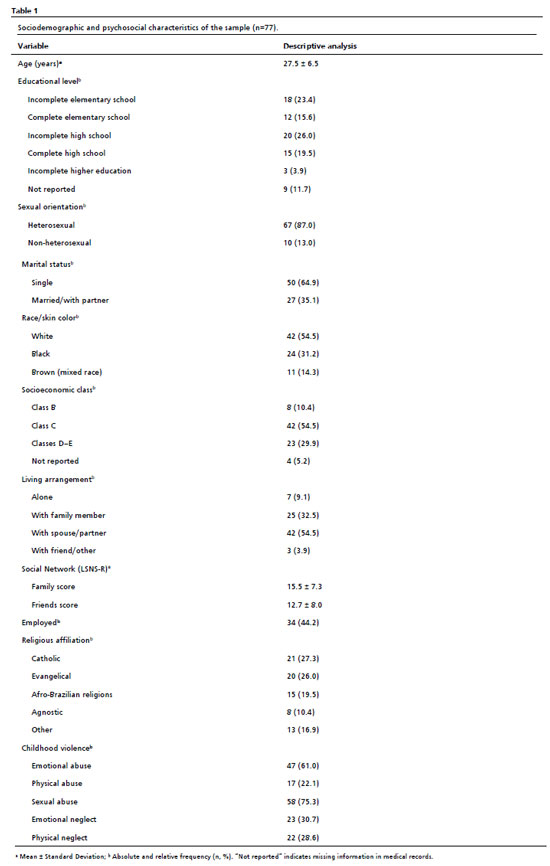
Regarding psychiatric diagnoses, the most frequently identified conditions were current major depressive episode (45.5%), psychoactive substance use disorder (39.0%), post-traumatic stress disorder (18.2%), and bipolar disorder (14.3%). The sample also presented high prevalence rates of childhood trauma, with sexual abuse reported by 75.3% of participants and emotional abuse by 61.0%.
Barriers to Accessing Mental Health CareThe BACE scale yielded a mean total score of 20.7 ± 19.9, and the stigma-related subscale presented the highest mean among all domains of the instrument (Table 2). In the descriptive analysis, considering barriers reported to any degree, the most frequently reported obstacles to mental health care were reluctance to talk about feelings, emotions, or thoughts (57.1%); the desire to deal with problems alone (54.5%); fear of involuntary hospitalization (51.9%); fear of being perceived as weak for having a mental health problem (44.4%); and concerns about potential loss of child custody or intervention by social services (41.8%) (Table 3).
Factors Associated with Barriers to Mental Health CareWhen examining associations between sociodemographic and psychosocial variables and BACE scores, higher BACE scores, reflecting greater perceived barriers to mental health care, were associated with emotional and physical childhood abuse (Figure 1). A history of emotional and physical childhood abuse was also associated with higher scores across all BACE subscales (Table 4). In this sense, women exposed to emotional abuse had higher barrier scores than those without exposure (median 25.0
vs 3.5;
p<0.001), with a large effect size (rank-biserial correlation=0.51; r=0.43). The Hodges-Lehmann estimator indicated a median difference of 14 points (95%CI=6–25). Women exposed to physical abuse had higher barrier scores than those without exposure (median 33.0
vs 9.5;
p=0.002), with a large effect size (rank-biserial correlation=0.50; r=0.35). The Hodges-Lehmann estimator indicated a median difference of 14 points (95%CI=6–29).
Sociodemographic variables such as age, marital status, socioeconomic class, and social support networks were not significantly associated with either total BACE scores or any of its subscale scores.
Women recruited during psychiatric hospitalization exhibited significantly higher total BACE scores compared with those recruited in the postnatal ward (median 18.0
vs. 3.0;
p=0.045). No significant differences were observed between women recruited in the inpatient unit and outpatient clinic nor between outpatient clinic and the postnatal ward. Women with a current major depressive episode presented higher perceived barrier scores than those without depression (median 24.0
vs. 6.0;
p=0.003), with a moderate effect size (rank-biserial correlation=0.40; r=0.34). The Hodges-Lehmann estimator indicated a median difference of 12 points (95%CI=3–22).
DiscussionWhen assessing barriers to mental health care among perinatal women with psychiatric disorders, this study found that stigma-related and attitudinal barriers were frequently reported, even among inpatient women, who were already within the health system. These findings align with previous evidence highlighting the high prevalence of barriers to mental health care among this population.
10,15 The most discouraging factors for help-seeking included a reluctance to talk about feelings, a desire to handle problems alone, and the fear of involuntary psychiatric hospitalization. Concerns about losing child custody or being unable to care for their children were also commonly reported. These results underscore the need for stigma-reduction strategies and humanized, trauma-sensitive approaches in perinatal mental health services.
Although stigma-related barriers showed the highest mean score on the BACE subscales, the most frequently reported barrier was attitudinal: difficulty talking about feelings. A Canadian study with 460 women found that over 70% preferred to manage their problems independently and felt uncomfortable discussing emotions, which may reflect a cultural orientation toward self-reliance and distrust in mental health services.
16 Qualitative studies have further revealed that the fear of being perceived as a "bad mother", along with the social silencing of maternal experiences, are important factors negatively associated with seeking mental health care.
17,18 Taken together, these findings highlight how cultural norms surrounding mental health and motherhood may act as barriers to accessing care.
Fear of involuntary hospitalization and of losing custody of children were also prominent deterrents to help-seeking. Despite Brazil's anti-asylum (
antimanicomial) policies, involuntary psychiatric admissions remain relatively common,
19 which may increase fear among perinatal women who are unaware of their rights or treatment policies. Moreover, although no official statistics exist in Brazil, the international literature indicates that 25–50% of parents with severe mental disorders lose legal custody of their children.
20 Thus, the fear of custody loss may contribute to high levels of psychological distress and the avoidance of mental health care, both within the health system and the social support network.
21Stigma toward mental disorders remains highly prevalent in many societies and constitutes a major barrier not only to treatment-seeking but also to recovery.
11,22 In perinatal contexts, women may avoid reporting psychiatric symptoms or substance use due to fear of being perceived as "unfit mothers" or as "crazy" or incapable.
23 Consistent with our results, previous studies have shown that fear of appearing weak or incapable of coping is a common reason for avoiding treatment, reflecting persistent stigma toward mental health in diverse settings.
24Notably, only a specific subset of psychosocial variables was significantly associated with higher BACE scores. Childhood trauma was highly prevalent in this sample, exceeding rates reported in studies of the general Brazilian population,
25 but comparable to those found among women with psychiatric disorders or low socioeconomic status.
26Higher BACE scores, reflecting greater perceived barriers to mental health care, were associated with childhood physical and emotional abuse. These findings support evidence that early adverse experiences may have a lasting impact on help-seeking in perinatal mental health, as women with a history of childhood trauma tend to exhibit greater self-stigma and distrust of health services, leading to treatment avoidance.
27The results indicated that emotional neglect was associated with higher median scores on the total BACE and on the stigma and attitudinal barrier subscales, suggesting greater perceived barriers to mental health care, although these differences did not reach statistical significance. Likewise, no statistically significant associations were observed between physical neglect and BACE scores. These findings suggest that experiences of neglect may be related to greater perceived barriers; however, this relationship appears less consistent than that observed for more explicit forms of trauma, such as emotional and physical abuse.
27,28It is plausible that the attitudinal barriers identified in this study may be shaped during personality development amidst adversity, highlighting the need for early detection and trauma-informed approaches in health services. Early screening has the potential to minimize negative consequences later in life and at particularly vulnerable periods such as pregnancy, thereby improving quality of life and preventing the escalation of symptoms, psychiatric hospitalization, and even custody loss.
26,28Women with a current major depressive episode presented higher BACE scores compared with those without this diagnosis. Possible explanations include fear of judgment, concerns about treatment safety during pregnancy, and the stigma associated with depression as a sign of weakness. Health professionals should also be mindful of indirect factors linked to depression, such as financial stress and perceived social burden.
28 Furthermore, women who required psychiatric hospitalization during pregnancy exhibited higher barrier scores than those in the postnatal ward, suggesting that greater clinical severity may be associated with stronger attitudinal resistance to seeking care.
29Evidence supports the effectiveness of psychoeducation campaigns, stigma-free communication, and integrated care models in reducing barriers and improving access to treatment.
23 A systematic review also highlighted that humanization strategies – such as supportive welcoming, active listening, and respectful prenatal interactions – may strengthen the connection between women, families, and health services, promoting a more humanized maternity care experience and potentially supporting prevention, health promotion, and risk-related care needs.
30 Coordinated multidisciplinary care, clear communication, longitudinal treatment planning, and continuity across clinical settings have been recommended internationally as core elements of perinatal mental health care.
1,8 Strengthening primary care as the main entry point and integrating mental health screening into routine prenatal care are key strategies for promoting equitable access to maternal mental health services.
8Some limitations of this study should be acknowledged. First, the investigation was conducted in a hospital setting among women who had already accessed the health system, which may have limited the identification of structural or geographical barriers faced by those entirely excluded from care. Additionally, the use of convenience sampling from a single center may restrict the generalizability of the findings to other contexts. Although no statistically significant associations were observed for some sociodemographic variables, post hoc power analyses indicated that the study was sufficiently powered to detect moderate to large effects for the primary outcomes. Therefore, the absence of associations with sociodemographic factors is unlikely to be explained solely by insufficient statistical power and may instead reflect genuinely small effect sizes or relative homogeneity within the sample.
The possibility of a type I error should also be considered, given the multiple comparisons performed. However, childhood trauma variables were defined as primary exposures of interest. Notably, associations between BACE scores and childhood emotional and physical abuse remained statistically significant even after a conservative Bonferroni correction, supporting the robustness of these findings. Additionally, the absence of formal sensitivity analyses represents a limitation. Given the exploratory nature of the study and the sample size, these findings should be regarded as hypothesis-generating, warranting confirmation through future studies employing alternative analytical strategies.
Further limitations relate to potential sources of bias. The coexistence of childhood trauma experiences and current depressive disorders may have resulted in residual confounding, as these exposures are often interrelated. Moreover, data collection through face-to-face interviews in a hospital environment may have introduced social desirability bias, potentially leading to the underreporting of traumatic experiences or perceived barriers to mental health care. The inclusion of participants from distinct care settings (inpatient units, outpatient clinics, and postnatal wards) may have introduced sample heterogeneity, potentially increasing variability in barrier scores and influencing the observed associations. These factors may have influenced the magnitude of the observed associations and should be considered when interpreting the results.
The cross-sectional design also precludes establishing temporal precedence. Although the study hypothesized that childhood trauma contributes to increased barriers to mental health care, it is also plausible that women experiencing greater barriers accumulate more adverse life experiences or are more likely to recall traumatic events due to current psychological distress, raising the possibility of recall bias. Longitudinal studies with more diverse samples are therefore needed to clarify the temporal dynamics of perceived barriers across the perinatal period and different care settings.
Despite these limitations, this study has several strengths. These include the use of gold-standard diagnostic interviews (SCID-5) rather than screening instruments, prospective consecutive sampling to reduce selection bias, and the inclusion of multiple psychosocial domains, such as childhood trauma, social support, and clinical severity. Furthermore, focusing on a high-risk population within Brazil's public health system and including psychiatric inpatients provided rare and valuable insights into perceived barriers among women with more severe clinical presentations. Collectively, these findings suggest that integrated care pathways may help address perceived barriers to mental health care, particularly among women with greater clinical severity, social vulnerability, and trauma histories.
These findings have direct implications for maternal health policies within the SUS. The
Rede Cegonha (Stork Network) initiative, established to improve maternal-child care quality, could benefit from integrating: (1) mandatory trauma screening during prenatal intake using validated instruments like the CTQ; (2) anti-stigma training modules for obstetric and primary care teams specifically addressing perinatal mental health misconceptions; (3) formalized referral protocols between Family Health Units and Psychosocial Care Centers (CAPS) to ensure treatment continuity; and (4) protection policies explicitly addressing pregnant women's fears regarding child custody, clarifying legal rights and support services available within the mental health network.
This study found an important frequency of stigma-related and attitudinal barriers to mental health care among perinatal women with psychiatric disorders, even among those already engaged with the healthcare system. Childhood trauma and current major depressive episodes were the variables most strongly associated with higher perceived barriers, highlighting the need for trauma-informed and stigma-sensitive approaches in perinatal care. To ensure timely and equitable access to mental health services, active screening, psychosocial support, and professional training are essential components of care. Improving integration between obstetrics, mental health, and primary care may reduce barriers, promote early detection, and improve maternal–child outcomes.
References1. Howard LM, Khalifeh H. Perinatal mental health: a review of progress and challenges. World Psychiatry. 2020; 19 (3): 313-27. doi: 10.1002/wps.20769
2. Wisner KL, Murphy C, Thomas MM. Prioritizing Maternal Mental Health in Addressing Morbidity and Mortality. JAMA Psychiatry. 2024; 81 (5): 521-6. doi: 10.1001/jamapsychiatry.2023.5648
3. Zhu Z, Wang H, Zhu T, Wang Z, Shen Y, Xiong C,
et al. Mental health service utilization among pregnant and postpartum women: status, determinants, and insights from a mixed-methods study. BMC Public Health. 2025; 25 (1): 1942. doi: 10.1186/s12889-025-23132-1
4. Santos GBV, Alves MCGP, Goldbaum M, Cesar CLG, Gianini RJ. Prevalência de transtornos mentais comuns e fatores associados em moradores da área urbana de São Paulo, Brasil. Cad Saúde Pública. 2019; 35: e00236318. doi: 10.1590/0102-311X00236318
5. Silva BP, Neves PAR, Mazzaia MC, Gabrielloni MC. Common mental disorders and perinatal depressive symptoms: an integrative review. Rev Bras Enferm. 2020;73: e20190823. doi: 10.1590/0034-7167-2019-0823
6. Howard LM, Molyneaux E, Dennis CL, Rochat T, Stein A, Milgrom J. Non-psychotic mental disorders in the perinatal period. Lancet. 2014; 384 (9956): 1775-88. doi: 10.1016/S0140-6736(14)61276-9
7. Alcantarilla L, López-Castro M, Betriu M, Torres A, Garcia C, Solé E,
et al. Risk factors for relapse or recurrence in women with bipolar disorder and recurrent major depressive disorder in the perinatal period: a systematic review. Arch Womens Ment Health. 2023; 26 (6): 737-54. doi: 10.1007/s00737-023-01370-9
8. Paulino D, Santos DVD, Santarosa MNM, Stefanello S, Carvalho DS. Pregnant women admitted to the psychiatric hospital: a portrait of vulnerability. Physis. 2022; 32: e320119. doi: 10.1590/S0103-73312022320119
9. Tato Fernandes F, Almeida AB, Fernandes M, Correia R, Magalhães R, Buchner G,
et al. Perinatal depression and mental health uptake referral rate in an obstetric service. Sci Rep. 2023; 13 (1): 10987. doi: 10.1038/s41598-023-33832-6
10. Webb R, Uddin N, Ford E, Easter A, Shakespeare J, Roberts N,
et al. Barriers and facilitators to implementing perinatal mental health care in health and social care settings: a systematic review. Lancet Psychiatry. 2021; 8 (6): 521-34. doi: 10.1016/S2215-0366(20)30467-3
11. Jones A. Postpartum Help-Seeking: The Role of Stigma and Mental Health Literacy. Matern Child Health J. 2022; 26 (5): 1030-7. doi: 10.1007/s10995-022-03399-1
12. Schnyder N, Panczak R, Groth N, Schultze-Lutter F. Association between mental health-related stigma and active help-seeking: systematic review and meta-analysis. Br J Psychiatry. 2017; 210 (4): 261-8. doi: 10.1192/bjp.bp.116.189464
13. Bina R, Glasser S. Factors associated with attitudes toward seeking mental health treatment postpartum. Women Health. 2019; 59 (1): 1-12. doi: 10.1080/03630242.2017.1421286
14. Perera E, Chou S, Cousins N, Mota N, Reynolds K. Women's experiences of trauma, the psychosocial impact and health service needs during the perinatal period. BMC Pregnancy Childbirth. 2023; 23 (1): 197. doi: 10.1186/s12884-023-05509-5
15. Webb R, Uddin N, Constantinou G, Ford E, Easter A, Shakespeare J,
et al. Meta-review of the barriers and facilitators to women accessing perinatal mental healthcare. BMJ Open. 2023; 13 (7): e066703. doi: 10.1136/bmjopen-2022-066703
16. Kingston D, Austin MP, Heaman M, McDonald S, Lasiuk G, Sword W,
et al. Barriers and facilitators of mental health screening in pregnancy. J Affect Disord. 2015; 186: 350-7. doi:10.1016/j.jad.2015.06.029
17. Law S, Ormel I, Babinski S, Plett D, Dionne E, Schwartz H,
et al. Dread and solace: Talking about perinatal mental health. Int J Ment Health Nurs. 2021; 30 (Suppl. 1): 1376-85. doi: 10.1111/inm.12884
18. Nagle U, Farrelly M. Women's views and experiences of having their mental health needs considered in the perinatal period. Midwifery. 2018; 66: 79-87. doi: 10.1016/j.midw.2018.07.015
19. Chang TMM, Ferreira LK, Ferreira MP, Hirata ES. Clinical and demographic differences between voluntary and involuntary psychiatric admissions in a university hospital in Brazil. Cad Saúde Pública. 2013; 29: 2347-52.
20. Torrico T, Fitzsimmons E, Patel S, Lopez J, Padhy R,
et al. Antenatal Psychiatric Hospitalization: Factors Associated With Newborns' Custody Under Child Protective Services. J Acad Consult Liaison Psychiatry. 2024; 65 (6): 519-26. doi: 10.1016/j.jaclp.2024.03.004
21. Weller P. Mothers and mental illness: Breaking the silence about child loss. Int J Law Psychiatry. 2019; 67: 101500. doi: 10.1016/j.ijlp.2019.101500
22. Fox AB, Smith BN, Vogt D. How and when does mental illness stigma impact treatment seeking? Longitudinal examination of relationships between anticipated and internalized stigma, symptom severity, and mental health service use. Psychiatry Res. 2018; 268: 15-20. doi: 10.1016/j.psychres.2018.06.036
23. Frew JR. Reducing the stigma of perinatal substance use disorders: the time is now. Arch Womens Ment Health. 2023; 26 (3): 411-3. doi: 10.1007/s00737-023-01322-3
24. Sorsa MA, Kylmä J, Bondas TE. Contemplating Help-Seeking in Perinatal Psychological Distress-A Meta-Ethnography. Int J Environ Res Public Health. 2021; 18 (10): 5226. doi: 10.3390/ijerph18105226
25. Bailey M, Fairchild G, Hammerton G, Bauer A, Carpena M, Murray J,
et al. Associations between childhood trauma and adolescent psychiatric disorders in Brazil: a longitudinal, population-based birth cohort study. The Lancet Global Health. 2025; 13 (2): e309-e318. doi: 10.1016/S2214-109X(24)00452-2
26. Tractenberg SG, Viola TW, Rosa CSO, Donati JM, Francke IA, Pezzi JC,
et al. Exposição a trauma e transtorno de estresse pós-traumático em usuárias de crack. J Bras Psiquiatr. 2012; 61: 206-13. doi:
https://doi.org/10.1590/S0047-2085201200040000327. Fares-Otero NE, De Prisco M, Oliva V, Radua J, Halligan SL, Vieta E, Martinez-Aran A. Association between childhood maltreatment and social functioning in individuals with affective disorders: A systematic review and meta-analysis. Acta Psychiatr Scand. 2023 Aug; 148 (2): 142-64. doi: 10.1111/acps.13557.
28. Haim-Nachum S, Lazarov A, Zabag R, Martin A, Bergman M, Neria Y,
et al. Self-stigma mediates the relationships between childhood maltreatment and symptom levels of PTSD, depression, and anxiety. Eur J Psychotraumatol. 2024; 15 (1): 2370174. doi: 10.1080/20008066.2024.2370174
29. Mojtabai R, Olfson M, Sampson NA, Jin R, Druss B, Wang OS,
et al. Barriers to mental health treatment: results from the National Comorbidity Survey Replication. Psychol Med. 2011; 41 (8): 1751-61. doi: 10.1017/S0033291710002291
30. Landeiro F, Silva M, Moura CV, Martins C, Miller P,
et al. Human-centered design and maternity care: is this a possible interplay? — a systematic review. BMC Pregnancy and Childbirth. 2025; 25 (1): 261. doi: 10.1186/s12884-024-07119-1
Author contributionSantos FS, Alves LPC, and Scherer JN: conceived the study and designed the methodology.
Santos FS, Oliveira VG, Althoff BF, Ferreira GG, Oliveira RLA, Araujo IS, Kieling SV, and Osório GL: recruited the participants and administered the data collection protocols.
Araujo IS, Kieling SV, and Osório GL: conducted data tabulation and organization.
Santos FS, Alves LPC, and Scherer JN: performed the statistical analyses.
Santos FS, Oliveira VG, Althoff BF, Ferreira GG, and Oliveira RLA: were responsible for data visualization.
All authors approved the final version of the article and declare no conflicts of interest.
AcknowledgementsWe acknowledge the Rio Grande do Sul State Research Foundation (FAPERGS) [grant number 22/2551-0000532-2] for their financial support. The first author was supported by a research fellowship from the Coordination for the Improvement of Higher Education Personnel (CAPES).
Use of artificial intelligenceArtificial intelligence (AI) tools were used solely to assist with language editing and improvement of clarity. All scientific content, analyses, and conclusions were developed and reviewed by the author(s), who take full responsibility for the work.
Data availabilityThe data that support the findings of this study are not publicly available due to ethical and confidentiality restrictions but are available from the corresponding author upon reasonable request, subject to ethics approval and institutional regulations.
Received on January 28, 2026
Final version presented on April 23, 2026
Approved on May 11, 2026
Associated Editor: Melania Amorim


 ; Vanessa Gorniak Oliveira2








 Download PDF
 Imprimir
 Enviar este artigo por email
 Como citar este artigo
 Enviar um comentário
 Mendeley
 Pocket
 Compartilhar no Facebook
 Compartilhar no Twitter