IntroductionLabor is one of the most important events in a woman's life, marked by intense physiological, emotional, and psychological changes.
1 The anxiety experienced during this period reflects pressures relating to maternal expectations, concerns about the baby's well-being, the birth process itself and the hospital environment.
2-4 Although a degree of anxiety in pregnancy may be considered normal, elevated levels of anxiety, stress and fear before or during labor have been associated with increased risk of fetal distress and a greater need for medical interventions during labor.
5-6Accurately measuring anxiety during labor is essential for guiding clinical decisions and tailoring interventions that support maternal emotional well-being.
7 In this context, establishing the minimal important difference (MID) and confirming the responsiveness of an anxiety scale are crucial, as they allow clinicians to determine whether observed score changes represent true, clinically meaningful variations rather than random measurement fluctuations.
8 This interpretability is particularly relevant during labor, when timely emotional support or therapeutic adjustments can directly influence maternal–fetal outcomes.
9 Therefore, using validated and responsive tools is essential to ensure accurate assessment of anxiety during this process.
Among the various instruments used to assess anxiety, the State-Trait Anxiety Inventory (STAI) is one of the most widely used both in Brazil and internationally. It distinguishes between state anxiety (a transient emotional reaction to a perceived threat) and trait anxiety (a person's general tendency to experience anxiety in daily life).
10 Because labor is an acute and emotionally intense situation, the state anxiety component (S-anxiety) is particularly relevant for understanding women's psychological responses during labor.
9The instrument was translated, adapted, and validated for the Brazilian population by Biaggio, Natalício, and Spielberger,
11 and recently the subscale of the inventory was validated and adapted for women in labor by Delgado
et al.
12 However, that validation focused primarily on construct validity and internal consistency, without evaluating the responsiveness of the instrument or establishing its MID. Instruments designed to measure health-related constructs must demonstrate reliability, validity, sensitivity, and, crucially, responsiveness to clinically meaningful changes.
13 Establishing these measurement properties allows health professionals to interpret whether score variations reflect real changes in a patient's condition or are simply due to measureerror, which is essential in labor management.
14Cross-cultural adaptation and validation studies of the STAI have also been conducted in countries such as Spain, Iran, and Turkey, demonstrating its applicability in different populations of women and revealing variations in factor structures depending on the cultural context.
15-17 However, despite these international findings, evidence regarding these measurement of properties in Brazilian women during labor, remains scarce.
Determining the responsiveness and Minimal Important Difference (MID) of the instrument allows professionals to interpret whether changes in scores reflect clinically meaningful improvements or worsening of anxiety, supporting decision-making during labor care. Given this context, it is important to assess responsiveness, determine the MID, and perform exploratory factor analysis, as these properties contribute to the use of a reliable, applicable scale that facilitates the identification of anxiety levels, enhancing results in clinical practice. Thus, the present study aimed to analyze responsiveness, establish the MID, and perform exploratory factor analysis of the S-anxiety subscale of the STAI for women in labor.
MethodsThis was a measurement property study approved by the Research Ethics Committee of the Health Sciences Center at the
Universidade Federal de Pernambuco (CAAE: 87566818.4.0000.5208; Report No. 3,135,617, approved on February 17, 2019). All participants provided written informed consent. Data collection occurred between September and December 2018 at the Obstetric Center of the
Hospital João Murilo de Oliveira, a public tertiary care hospital that provides emergency obstetric care throughout Brazil, in the
Sistema Único de Saúde (SUS) (Public Health System), located in
Vitória de Santo Antão, Pernambuco. The institution serves a population from both urban and rural areas of the
Zona da Mata region.
The study included pregnant women in the active phase of labor, aged 15-45 years, with full-term pregnancies (37-41 weeks), classified as low obstetric risk according to the criteria established by the Brazilian Ministry of Health. Women with clinical instability, cognitive impairment, or have difficulty to understand the subscale items were excluded. The sample reflected the typical sociodemographic profile of users assisted by the hospital, which mainly serves the population in social and economic vulnerability. Sampling was non-probabilistic, based on eligibility criteria, which limits generalizability and is acknowledged as a methodological limitation.
The sample size for assessing responsiveness and MID was determined according to the COnsensus-based Standards for the selection of health Measurement INstruments (COSMIN) and Terwee
et al.,
18 which consider a sample of 50 participants sufficient to assess the responsiveness of health instruments.To perform the factor analysis, the sample size was determined based on Hair et al., who suggest that the ratio between the number of cases and the number of variables in the scale should exceed five for one or more.
19 With a sample of 100 participants and a subscale of 19 items, the present study achieved a ratio of 5.26.
Women in labor who met the eligibility criteria were referred for two assessments: Assessment 1 (A1), performed during the first stage of labor, and Assessment 2 (A2), conducted 6 hours after A1. In A1, an assessment form was used to collect personal, clinical, obstetrical, and sociodemographic data. The STAI S-anxiety subscale was also applied, adapted for women in labor, and was administered in an interview format,
12 as it would be difficult and inappropriate to use a self-administered format in the context of labor. The mean duration of the interview was between 5 and 10 minutes, conducted while the women in labor were free of pain or discomfort that would hinder their ability to respond. If any woman reported pain or discomfort, the interviews were interrupted and resumed only when symptoms improved. Assessment 2 involved the reapplication of the STAI subscale 6 hours after A1. The six-hour interval between assessments was adopted because it corresponds to the average rate of cervical dilation progression (1 cm/hour) during the active phase of labor, enabling follow-up of clinical evolution. However, this period may be insufficient to detect clinically significant changes in anxiety levels and should be acknowledged as a limitation.
The STAI adapted for women in labor consisted of 19 items, which were classified on a 4-point Likert scale: 1 - definitely not; 2 - a little; 3 - a lot; 4 - very much. The scoring for items related to an absence of anxiety is reversed, meaning responses marked with 1, 2, 3, or 4 are scored 4, 3, 2, or 1, respectively. The non-anxiety items for which scoring weights are reversed in the STAI subscale adapted for women in labor are items 1, 2, 4, 7, 9, 10, 14, 15, 18, and 19. The final scores varied between 19 and 76 points, with higher values indicating higher anxiety scores.
12,20Statistical analysis was performed using IBM SPSS Statistics 25.0 (Statistical Package for the Social Sciences) and, for the reanalysis of factor structure, R software (version 4.3.0), considering the ordinal nature of the data. Continuous variables were expressed as mean and standard deviation, mean difference with 95% confidence interval (CI), or median and interquartile range. Categorical variables were expressed as number of cases and relative frequency; where relevant, the relative risk was calculated. The sums of the STAI scores in A1 and A2 were normally distributed according to the Kolmogorov-Smirnov normality test.
To assess responsiveness, the two assessments (A1 and A2) were compared using the paired t-test. Effect size (ES) and standardized response mean (SRM) were calculated with their respective 95% CIs to evaluate responsiveness.
21-23 According to Cohen's criteria, values ≥0.20 and <0.50 indicate low responsiveness, values between ≥0.50 and <0.80 indicate moderate responsiveness and values ≥0.80 indicate excellent responsiveness.
24After evaluating the responsiveness of the instrument, the standard error of measurement (SEM) was used to calculate the MID, determined by multiplying SEM by 1.96 × √2, in accordance with distribution-based recommendations.
25 Cronbach's alpha was used to assess the internal consistency of the instrument, with acceptable values ranging from 0.70 to 0.95. The Bartlett sphericity test and the Kaiser-Meyer-Olkin (KMO) adequacy index were used to verify whether the questionnaire was suitable for factor analysis, with a KMO value greater than 0.5 considered acceptable for satisfactorily conducting and interpreting a factor analysis solution.
Exploratory factor analysis was performed using Principal Axis Factoring (PAF) with Promax oblique rotation, an approach suitable for psychological constructs in which factors are expected to be correlated. Item correlations were computed from the polychoric correlation matrix, given the ordinal nature of Likert-type data. The number of factors to extract was determined using the Kaiser criterion (eigenvalues >1.0) and confirmed by parallel analysis, a more robust method for identifying latent dimensions. Factor loadings below 0.30
26 were suppressed. Factors were interpreted according to item content: items grouped in Factor 1 represented the absence of anxiety, while those in Factor 2 reflected the presence of anxiety. Factors with fewer than three items were interpreted with caution due to potential psychometric instability. All tests were two-tailed, adopting a significance level of
p<0.05.
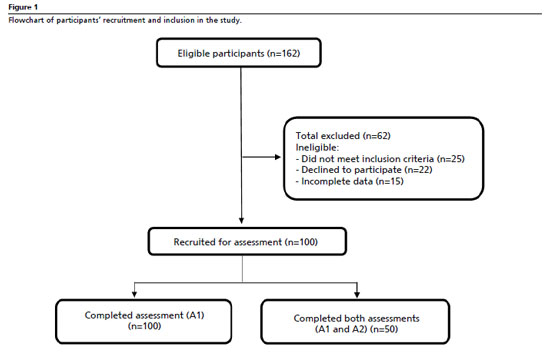
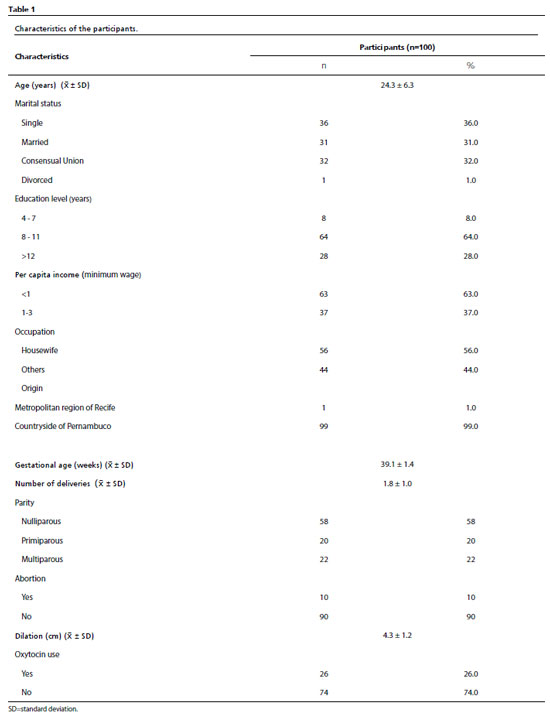
ResultsIn the present study, 162 women were screened, of whom 62 were excluded: 25 did not meet the inclusion criteria, 22 declined to participate, and 15 had incomplete data. Thus, 100 women were included in Assessment 1 (A1), of whom 50 completed Assessment 2 (A2), resulting in a loss to follow-up of 50 participants (50%). Losses between A1 and A2 were mainly due to early hospital discharge or clinical conditions that prevented reassessment. Women who completed A2 had a mean age of 23.2 ± 5.6 years, a mean cervical dilation of 3.8 ± 0.8 cm at A1, and a baseline STAI score of 44.2 ± 8.6, while those lost to follow-up had a mean age of 25.4 ± 6.8 years, a mean cervical dilation of 4.8 ± 1.4 cm, and a baseline STAI score of 44.0 ± 9.1. Oxytocin use at A1 was reported in 22% of women who completed A2 and 30% of those lost to follow-up. Overall, baseline characteristics were similar between groups. The sample profile is presented in Table 1, and the participant flow is shown in Figure 1.
Comparing the two assessment time points using the paired t-test, a slight increase of 2.1 points in anxiety scores was observed (95%CI= 0.4–3.7;
p=0.016). The mean scores were 44 (SD 8.6) in A1 and 46 (SD 6.2) in A2. The effect size (ES) was 0.21 (95%CI=0.05–0.37) and the standardized response mean (SRM) was 0.29 (95%CI= 0.11–0.47), both indicating low responsiveness. The standard error of measurement (SEM) was 4.0, resulting in a MID of 11.2 points, as shown in Table 2.
To perform the exploratory factor analysis, the adequacy of the sample for factor analysis was confirmed by Bartlett's test of sphericity (χ
2 = 664.6;
p<0.001) and by the Kaiser-Meyer-Olkin (KMO) measure of 0.767, indicating sufficient inter-item correlations to justify the use of EFA.
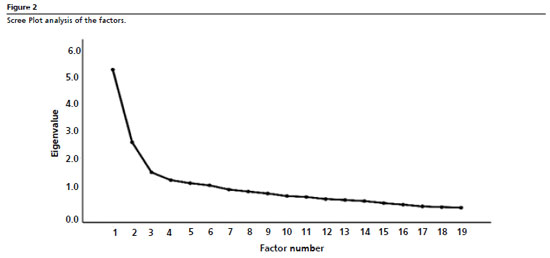
9The EFA was conducted using the Principal Axis Factoring (PAF) extraction method with Promax oblique rotation, based on a polychoric correlation matrix due to the ordinal nature of the items. The number of factors to be retained was determined by the Kaiser criterion (eigenvalues >1.0) and confirmed through parallel analysis and inspection of the scree plot (Figure 2), which supported a two-factor structure explaining 46.2% of the total variance. Factor loadings ranged from 0.32 to 0.78.
Factor 1 grouped 17 items and predominantly reflected the absence of anxiety, presenting higher loadings and greater explained variance (27.49%), with a Cronbach's alpha of 0.84. Factor 2 represented the presence of anxiety and showed its highest and most conceptually coherent loadings on items 8 ("I feel anxious") and 12 ("I feel restless"). Several items exhibited cross-loadings across both factors; however, the two-factor solution was retained based on theoretical coherence and consistency with previous studies. Factor 2 explained 13.58% of the variance and showed acceptable internal consistency (Cronbach's alpha = 0.71). Item 5 ("I feel disturbed") was excluded due to factor loadings below 0.30 across both factors. The revised structure demonstrated satisfactory internal consistency, with Cronbach's α = 0.88 for the overall subscale (Table 3).
DiscussionThe present study established a MID of 11.2 points for the S-anxiety subscale of the STAI adapted for women in labor, which represents the minimum value required to exceed measurement error and support the interpretation of score changes during labor. The MID provides a distribution-based reference for interpreting score changes beyond measurement error and may serve as a reference value for future research.
25During the 6-hour period between A1 and A2, the subscale was able to identify a slight increase in anxiety scores at A2, corroborating Tzeng
et al.,
27 who identified a progressive increase in anxiety throughout labor, as labor is associated with physiological factors that influence increased energy expenditure, pain and fatigue symptoms, and elevated anxiety levels.
27The responsiveness of the instrument was classified as low, indicating that the subscale detected statistically but not clinically relevant changes, as the mean difference of 2 points was below the MID threshold of 11.2 points. The ES of 0.21 and the SRM of 0.29 fall within the ‘small' range according to Cohen's criteria, reinforcing the interpretation of low responsiveness in a scenario without specific intervention. The low responsiveness may be attributed to the short six-hour interval, which may not have been sufficient to capture meaningful changes in the emotional state of women in labor.
27 Additionally, no psychological or clinical interventions were performed between assessments, which could have influenced responsiveness.
2,5 Thus, the subscale demonstrated responsiveness consistent with the study design, although more robust results would require assessment at different time points or after interventions.
Similar results were observed in the study by Delgado
et al.,
12 which validated the version of the STAI adapted for Brazilian women in labor and also found low responsiveness. In contrast, studies conducted in other cultural contexts identified variations in factorial structure and internal consistency of the instrument, as reported by Abdoli
et al.
16 and Döner
et al.
17 These findings highlight that cultural and contextual characteristics may influence the psychometric performance of the STAI, reinforcing the importance of cross-cultural evaluation.
In the present study, the exploratory factor analysis revealed two dimensions: one reflecting the absence of anxiety and the other representing its presence, consistent with previous psychometric studies of the STAI that describe a bidimensional structure based on positive-affect and negative-affect items.
15,17 Although the second factor was primarily defined by two items and some items exhibited cross-loadings across dimensions, its retention was theoretically justified, as similarly reduced factor structures have been reported and accepted in cross-cultural adaptations of the instrument.
15-17 Factors defined by fewer than three items should be interpreted with caution due to potential psychometric instability; however, the consistency of this structure with previous cross-cultural adaptations supports its provisional validity in this context. The overall Cronbach's alpha of 0.88 indicated excellent internal consistency, meeting established criteria for reliability in health measurement instruments.
18 Furthermore, the internal consistency findings were consistent with previous validations of the STAI among women in labor.
12From a measurement perspective, the 11.2-point MID value provides a distribution-based reference for interpreting changes in anxiety scores during labor.
8,14,25 Changes smaller than this threshold are more likely to reflect measurement variability rather than meaningful changes.
8,21 This interpretation may support the analytical use of the instrument in research settings and guide future investigations exploring its potential clinical applicability.
5,6 Future studies should perform confirmatory factor analyses (CFA
18,19) to verify the stability of the identified factorial structure and employ anchor-based
13 approaches to determine the MID, using external criteria such as maternal perception or clinical outcomes. Therefore, the MID estimated in this study should be interpreted as a distribution-based reference rather than a patient-perceived minimal clinically important difference.
The original version of the S-anxiety subscale of the STAI presents a score per item classified as 1 to 4 points on the Likert scale.
20 The sum of the items results in a variation between 20 and 80 points; after adaptation for labor by Delgado
et al.,
12 the subscale score ranged from 19 to 76 points. In this study, with the exclusion of item 5 - "I feel disturbed", the subscale score for labor ranged from 18 to 72 points.
To our knowledge, this is the first study to determine the MID and assess the responsiveness of the STAI subscale adapted for women in labor. These findings contribute to a better understanding of its measurement of properties and provide a methodological basis for future studies investigating its potential clinical applications.
As perspectives for future studies, it is suggested that responsiveness should be assessed after an intervention and at different moments during labor, considering the increase in uterine dynamics to detect variations in peaks of anxiety throughout labor. It is also recommended that an anchor-based method be employed to assess the MID, using external anchors such as maternal self-report, clinical observations, or relevant obstetric outcomes to establish whether the magnitude of change is clinically meaningful.
13,14,25This study presents some limitations. The sample was composed of women assisted at a single public health institution, which may restrict the generalizability of the results. Responsiveness was assessed over a short 6-hour interval, without interventions that could affect anxiety levels. Additionally, the loss of participants between A1 (n=100) and A2 (n=50) may introduce selection bias; however, a descriptive comparison of baseline characteristics between women who completed A2 and those lost to follow-up did not reveal relevant differences, suggesting a limited impact of attrition on the responsiveness results. Moreover, additional analytical approaches could have strengthened the estimation of the MID.
13,25 Future studies should consider different moments during labor, apply targeted interventions, and combine methodological approaches to enhance the robustness of the findings.
It can be concluded that an 11.2-point change in the S-anxiety subscale of the STAI adapted for women in labor represents a distribution-based threshold for interpreting score changes beyond measurement error. Given the low responsiveness observed over the 6-hour interval following the first assessment during the active phase of labor, it is recommended that this property be evaluated in future studies after an intervention and at different moments during labor. Factor analysis revealed good internal consistency, and item 5, "I feel disturbed", was eliminated. The adapted subscale scores ranged from 18 to 72 points. Although the subscale demonstrated satisfactory internal consistency and a coherent factorial structure, further studies incorporating interventions and different labor stages are necessary to better establish its responsiveness and clinical applicability.
References1. Olza I, Uvnäs-Moberg K, Ekström-Bergström A, Leahy-Warren P, Karlsdóttir SI, Nieuwenhuijze M,
et al. Birth as a neuro-psycho-social event: An integrative model of labour and birth. PLoS One. 2020; 15 (7): e0230992.
2. Fairbrother N, Collardeau F, Albert A, Stoll K. Screening for Perinatal Anxiety Using the Childbirth Fear Questionnaire: A New Measure of Fear of Childbirth. Int J Environ Res Public Health. 2022; 19 (4): 2223.
3. Meades R, Sinesi A, Williams LR, Delicate A, Cheyne H, Maxwell M,
et al. Evaluation of perinatal anxiety assessment measures: A cognitive interview study. BMC Pregnancy Childbirth. 2024; 24: 507.
4. Val A, Míguez MC. Detecting Anxiety in Pregnancy: Validation of the Anxiety Subscale of the Edinburgh Postnatal Depression Scale (EDS-3A) in Spanish Women. J Child Fam Stud. 2025; 34: 1676-85.
5. Grigoriadis S, Graves L, Peer M, Mamisashvili L, Tomlinson G, Vigod SN,
et al. Maternal Anxiety During Pregnancy and the Association With Adverse Perinatal Outcomes: Systematic Review and Meta-Analysis. J Clin Psychiatry. 2018; 79 (5): 17r12011.
6. Sanni KR, Eeva E, Noora SM, Laura KS, Linnea K, Hasse K,
et al. The influence of maternal psychological distress on the mode of birth and duration of labor: findings from the Finn Brain Birth Cohort Study. Arch Womens Ment Health. 2022; 25 (2): 463-72.
7. Sinesi A, Maxwell M, O'Carroll R, Cheyne H. Anxiety scales used in pregnancy: A systematic review. BJPsych Open.2019; 5 (1): e5.
8. Kroenke K, Wu J, Yu Z, Bair MJ, Kean J, Stump TE,
et al. Comparative responsiveness and minimally important difference of six PROMIS anxiety measures. Med Care. 2019; 57 (11): 890-7.
9. Delgado A, Góes PSA, Lemos A. Assessment of responsiveness and minimum important difference of the Maternal Perception of Childbirth Fatigue Questionnaire (MCFQ). ABCS Health Sci. 2022; 48: e023204.
10. Leal PC, Costa Goes T, Ferreira da Silva LC, Teixeira-Silva F. Trait vs. state anxiety in different threatening situations. Trends Psychiatry Psychother. 2017; 39 (3): 147-57.
11. Biaggio AMB, Natalicio L, Spielberger CD. Desenvolvimento da forma experimental em português do Inventário de Ansiedade Traço-Estado (IDATE). Arq Bras Psicol Apl. 1977; 29: 31-44.
12. Delgado A, Freire AB, Wanderley ELS, Lemos A. Analysis of the construct validity and internal consistency of the State-Trait Inventory (STAI) State-Anxiety (S-Anxiety) Scale for pregnant women during labor. Rev Bras Ginecol Obstet. 2016; 38: 531-7.
13. Prinsen CAC, Mokkink LB, Bouter LM, Alonso J, Patrick DL, de Vet HCW,
et al. COSMIN guideline for systematic reviews of patient-reported outcome measures. Qual Life Res. 2018; 27 (5): 1147-57.
14. Barbosa-Silva J, Calixtre LB, Von Piekartz D, Driusso P, Armijo-Olivo S. The minimal important difference of patient-reported outcome measures related to female urinary incontinence: a systematic review. BMC Med Res Methodol. 2024; 24: 60.
15. Buela-Casal G, Guillén-Riquelme A. Short form of the Spanish adaptation of the State–Trait Anxiety Inventory. Int J Clin Health Psychol. 2017; 17 (3): 261-8.
16. Abdoli N, Farnia V, Salemi S, Davarinejad O, Ahmadi Jouybari T, Khanegi M,
et al. Reliability and validity of the Persian version of the State–Trait Anxiety Inventory among high school students. East Asian Arch Psychiatry. 2020; 30 (2): 44-7.
17. Döner S, Efe YS, Elmali F. Turkish adaptation of the State–Trait Anxiety Inventory short version (STAIS-5 and STAIT-5). Int J Nurs Pract. 2024; 30 (6): e13304.
18. Terwee CB, Bot SD, de Boer MR, van der Windt DA, Knol DL, Dekker J,
et al. Quality criteria for measurement properties of health status questionnaires. J Clin Epidemiol. 2007; 60: 34-42.
19. Hair JF, Black WC, Babin BJ, Anderson RE. Multivariate Data Analysis. 7
th ed. New Jersey: Prentice Hall; 2014.
20. Spielberger CD; Gorsuch RL, Lushene R, Vagg PR, Jacobs GA (colab.). State-Trait Anxiety Inventory for adults: sampler set manual, instrument and scoring guide. Palo Alto, CA: Consulting Psychologists Press; 1983. Published by Mind Garden. Available from:
https://www.studocu.com/in/document/modern-college-of-arts-science-and-commerce/psychology/stai-inventory-manual-anxiety-assessment-guide-for-adults/13381154121. Angst F. The new COSMIN guidelines confront traditional concepts of responsiveness. BMC Med Res Methodol. 2011; 11: 1-6.
22. Sierevelt IN, Eekeren ICM, Haverkamp D, Reilingh ML, Terwee CB, Kerkhoffs GM. Evaluation of the Dutch version of the Foot and Ankle Outcome Score (FAOS): responsiveness and minimally important change. Knee Surg Sports Traumatol Arthrosc. 2016; 24: 1339-47.
23. Hukuda ME, Veríssimo TAS, Fávero FM, Voos MC, Oliveira ASB, Caromano FA. O método nas pesquisas sobre a responsividade de escalas que avaliam doenças neurológicas. Cad Pós-Grad Distúrb Desenvolv. 2016; 16: 17-24.
24. Nitsch GS, Mella EB, Chaves TC, Oliveira AS. Propriedades clinimétricas da variável eletromiográfica duty factor para desordem temporomandibular. Audiol Commun Res. 2015; 20: 69-75.
25. Klukowska AM, Vandertop WP, Schröder ML, Staartjes VE. Calculation of the minimum clinically important difference (MCID) using different methodologies: case study and practical guide. Eur Spine J. 2024; 33(9): 3388-400.
26. Crick K, Al Sayah F, Ohinmaa A, Johnson JA. Responsiveness of the anxiety/depression dimension of the 3- and 5-level versions of the EQ-5D in assessing mental health. Qual Life Res. 2018; 27: 1625-33.
27. Tzeng YL, Yang YL, Kuo PC, Lin YC, Chen SL. Pain, Anxiety, and Fatigue During Labor: A Prospective, Repeated Measures Study. J Nurs Res. 2017; 25 (1): 59-67.
Authors' contributionSantos ACS: contributed to manuscript writing and revision.
Delgado A: contributed to the development of the theoretical framework.
Lemos A: conceived the study and contributed to the theoretical framework.
Siqueira GR: contributed to data interpretation.
Maia JN: contributed to data interpretation.
Álvares R: conceived the study, developed the theoretical framework, conducted the experiment, and wrote the manuscript.
All authors approved the final version of the article and declare no conflits of the interest.
Data availabilityThe entire data set supporting the results of this study has been published in the article itself.
Received on August 3, 2025
Final version presented on February 19, 2026
Approved on March 11, 2026
Associated Editor: Melania Amorim


 ; Alexandre Delgado2








 Download PDF
 Imprimir
 Enviar este artigo por email
 Como citar este artigo
 Enviar um comentário
 Mendeley
 Pocket
 Compartilhar no Facebook
 Compartilhar no Twitter