IntroductionCongenital anomalies (CA) affect about 6% of children worldwide, resulting in a considerable proportion of deaths.
1 Congenital heart disease (CHD) is among the most frequent CA, with a global prevalence of 94.1/10,000 from 2010 to 2017, and regional differences, explained, in part, by greater or lesser access to diagnosis.
2 In Europe, from 2005 to 2023, CHD prevalence was 72.5/10,000 births.
3 Globally, CHD is a frequent cause of death, mainly in children under five years of age, with inequalities between countries according to income levels.
4In Brazil, CHD is included in the "List of priority congenital anomalies at birth for surveillance" (LCA), those diagnosable at birth and amenable to preventive intervention,
5 including codes Q20 to Q28 of the International Statistical Classification of Diseases and Related Health Problems, 10
th Revision – ICD-10.
6 However, in 30% of CHD cases, the diagnosis is not made in time to be reported to the
Sistema de Informações sobre Nascidos Vivos (Sinasc) (Live Birth Information System), the only official and universal source of CA surveillance in Brazil, as the condition does not manifest in the first weeks of life.
7 Therefore, the frequency of CHD in the country is underestimated. Additionally, it is estimated that 20% of children with CHD die in the first year of life, and these cases can be detected with data from the
Sistema de Informações sobre Mortalidade (SIM) (Mortality Information System).
7,8National studies have estimated CHD prevalence between 6.5 and 14.9/10,000 births.
8-12 In the State of Rio de Janeiro (RJ), from 2019 to 2021, CHD prevalence was 6.5/10,000 births.
13 These differences can be explained, in part, by methodological differences, mainly in relation to the population base – only live births, or addition of deaths – and the selected ICD-10 codes.
3,7 Codes Q20 to Q26 refer to structural anomalies of the heart and great vessels, and are considered strictly congenital heart diseases, while codes Q27 and Q28 address anomalies of the circulatory system, in other organs or in peripheral vessels, without heart involvement.
3,6The objective of this study was to estimate the partial prevalence of CHD, identifiable through linked Sinasc and SIM records, including CHD recorded at birth and among fetal and infant deaths, and fetal and infant mortality due to CHD in a birth cohort from Rio de Janeiro city (2018-2022).
MethodsWe conducted a population-based retrospective birth cohort study, encompassing both live births (LB) and stillbirths or fetal deaths (SB) from 2018 to 2022 in Rio de Janeiro city. All newborns and stillbirths weighing ≥500g and/or with a gestational age ≥22 weeks were eligible. Infant deaths from 2018 through 2023 were included only when the child belonged to one of the 2018-2022 birth cohorts; deaths in 2018 among children born in 2017 and deaths in 2023 among children born in 2023 were excluded, while deaths in 2023 among children born in 2022 remained eligible if they occurred before 365 days of age.
The data sources are the Live Birth Information System
(Sistema de Informações sobre Nascidos Vivos - Sinasc) and Mortality Information System (
Sistema de Informações sobre Mortalidade - SIM) of the Health Department of RJ State (SES-RJ). The Sinasc and SIM (infant deaths) databases were linked deterministically using the LB Certificate Number (key variable). In a manual review, the variables "mother's name", "date of birth", "gender", and "birth weight" were checked to confirm the linked pairs and to identify pairs where information on the variable key was missing in the mortality database. Also, these variables were used to resolve ambiguities (such as duplicate records or spelling variations). All linkage steps were performed by the first author at SES-RJ, and the linked database was transferred to the researchers without identifiers ("mother's name", "mother's address" and "LB Certificate Number").
LB were classified according to CHD record in Sinasc, corresponding to codes Q20 to Q26 of ICD-10.
6 For codes Q25.0 (Patent ductus arteriosus) and Q25.6 (Pulmonary artery stenosis), only births with a gestational age ≥ 37 weeks were included, according to the European Surveillance of Congenital Anomalies (EUROCAT) guidelines.
14 This is because both conditions can manifest in premature infants but may be transient.
Fetal and infant deaths were analyzed according to underlying cause, groups, and specific causes up to four digits (ICD). Furthermore, all other causes (associated causes) recorded on the Death Certificate (DC) were considered for analysis. In cases where a specific CHD was the underlying cause, regardless of other associated heart conditions, its classification (underlying cause) was maintained. The classification of CHD as an associated cause applied to those present in DC, but whose underlying cause was not heart disease. CHD as a multiple cause of death comprises CHD as the underlying and/or an associated cause.
15The unit of analysis is the individual (child or fetal death). Each birth was counted only once, regardless of the number of CHD recorded. The components of infant mortality were early (up to six days) and late (from seven to 27 days) neonatal, and post-neonatal (from 28 to 364 days). CHD frequency was described: 1) according to the time of record, and the source of information (Sinasc or SIM) and 2) considering the entire birth cohort. According to the time, we included the records at birth (Sinasc for LB and SIM for CHD as multiple causes of fetal deaths) and after birth (SIM for CHD as multiple causes of infant deaths: total, neonatal and post-neonatal), without records at birth (Sinasc), following the method used by Fernandes
et al.
9 At birth, the following prevalences were calculated: a) LB - number of LB with CHD /10,000 LB, b) Fetal Deaths –number of SB with CHD /10,000 SB, c) Births – the sum of LB and SB with CHD /10,000 births.
3 After birth, the prevalence was calculated as the number of deaths with CHD /10,000 LB. Considering the entire birth cohort, CHD prevalence was calculated by dividing the sum of CHD (LB and SB) and of CHD infant deaths per 10,000 births. As we used only vital statistics, the estimates are considered partial prevalences.
The distributions of fetal and infant deaths were described according to the CHD record as the underlying cause or only as an associated cause, at any age. CHD was described as an underlying or associated cause, and for infant deaths, according to the record in the Sinasc. Fetal mortality rate (number of fetal deaths /10,000 births); infant, neonatal, and post-neonatal mortality rates were calculated, both total and according to CHD. The most frequent specific causes of CHD (up to four-character subcategories - ICD-10) in the birth cohort were described, as well as the CHD recorded in Sinasc for infant deaths. The respective 95% confidence intervals (95%CI) for the prevalence and mortality indicators were calculated using the Wilson score method for the prevalence estimates and the Mid-P exact method for the mortality rates. We used Stata and OpenEpi for analysis.
This study was approved by the Research Ethics Committee of the Institute of Collective Health of
Universidade Federal Fluminense (CAAE Nº 713230230000005243; reviewer's report Nº 6.592.725 of 12/19/2023).
This study adhered to the STROBE recommendations for reporting observational studies.
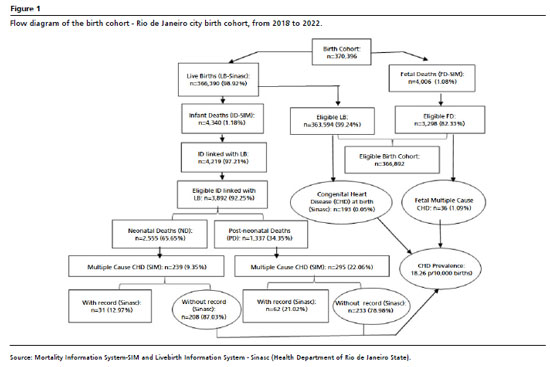
ResultsThe birth cohort comprised 366,390 LB and 4,006 SB. Of these, 363,594 LB (99.24%) and 3,298 SB (82.33%) were eligible. Missing information on birth weight and gestational age of the LB (Sinasc) was 0.001% and 0.61%, respectively, and for fetal deaths (SIM) it was 1.02% and 5.17%. There were 4,340 infant deaths, with 4,219 (97.21%) linked to live birth records in the Sinasc, and 3,892 (92.25%) of them were eligible: 1,740 (44.71%) early neonatal deaths, 815 (20.94%) late neonatal deaths, and 1,337 (34.35%) post-neonatal deaths. The total study population comprised 366,892 births. A total of 193 CHD was recorded among newborns (Sinasc) and 36 among fetal deaths (multiple cause – SIM), resulting in 229 CHD identified at birth. For infant deaths without CHD recorded at birth in the Sinasc, the presence of heart conditions was identified from multiple causes of death analysis, resulting in 208 neonatal, 233 post-neonatal, and 441 total infant deaths, respectively (Figure 1).
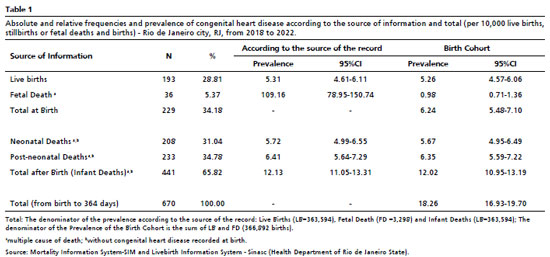
In the birth cohort, CHD prevalence recorded in the Sinasc database was 5.26 per 10,000 births. When considering multiple causes of fetal deaths, this prevalence increased to 6.24/10,000 births. CHD prevalence in the fetal death registry was much higher, 109.16/10,000 stillbirths. Linkage and multiple-cause analysis identified 441 additional CHD cases among infant deaths without CHD recorded at birth, increasing the partial prevalence estimate to 18.26 per 10,000 births (Table 1).
The three most frequently occurring CHD as isolated anomalies or in combination with other anomalies (Sinasc) were: "Congenital malformation of heart, unspecified" - Q24.9 (99: 58 survivors and 41 infant deaths), "Other specified congenital malformations of heart" - Q24.8 (16: 7 survivors and 9 infant deaths), and "Ventricular septal defect" - Q21.0 (12 survivors and zero infant deaths). There was no preterm LB with codes Q25.0 or Q25.6 registered in the Sinasc. The only LB with Q25.0 registered in Sinasc was a term neonate.
The infant mortality rate was 107.04/10,000 LB, mainly in the neonatal period (70.27/10,000 LB), and the fetal mortality rate was 89.89/10,000 births. Considering only CHD as the underlying cause, fetal mortality had the lowest CHD death rate (0.71/10,000 births), while neonatal and post-neonatal rates were 4.68 and 5.03/10,000 live births, respectively. When the CHD-associated cause (multiple causes) was also considered, we observed the importance of this cause in the profile of fetal, neonatal, and post-neonatal mortality (Table 2).
CHD was mainly certified as the underlying cause, particularly for infant deaths, regardless of the record in the Sinasc (Figure 2). The ratios between underlying and associated causes of post-neonatal deaths were about 1.35 (without a record in the Sinasc) and 3.77 (with a record in the Sinasc); for neonatal deaths, about 2.88 (with a record in the Sinasc) and 2.41 (without a record in the Sinasc), and for fetal deaths, about 2.60.
The most frequent causes of death (underlying or associated cause) from CHD were codes Q24.9 and Q24.8 (Table 3). "Hypoplastic left heart syndrome" (Q23.4) was also frequent, but only in infant deaths.
Six neonatal deaths and the six post-neonatal deaths from "Congenital malformation of heart, unspecified" (Q24.9) as multiple-cause had the same CHD recorded in the Sinasc. The predominance of the CHD agreement pairs (SIM multiple causes and Sinasc) was observed for codes Q24.9 (12 agreement vs 9 disagreement pairs) and Q23.4 (5 vs 1), but not for Q24.8 (1 vs 4). Regarding the certification of heart conditions on codes Q24.8, Q24.9, and Q23.4 as only an associated cause, matching records (SIM-Sinasc) occurred only for code Q24.9 (two neonatal and two post-neonatal pairs). The two disagreement pairs were: 1) Q24.9 as an associated cause (SIM) and code Q24.8 in the Sinasc, and 2) Q24.8 as associated cause (SIM) and code Q24.9 in the Sinasc.
DiscussionIn the Rio de Janeiro birth cohort (2018-2022), based on the Sinasc and SIM, CHD showed a prevalence of 18.26/10,000 births, fetal mortality of 0.71/10,000 births and infant mortality of 9.71/10,000 LB. The main CHD recorded in the Sinasc and SIM were nonspecific diagnoses, and for infant deaths, there was low agreement between the Sinasc and SIM diagnoses.
There is great variation in CHD estimates, partly explained by differences in the population base and ICD-10 codes, which limits comparability. In Brazil, covering only LB (Sinasc) and considering codes Q20 to Q26, the national prevalence estimate, between 2011 and 2020, was 9.3/10,000 LB.
10 Souza
et al.
11 included codes Q20 to Q28, from 2012 to 2022, and found 8.8/10,000 LB. Gomes
et al.
12 used codes Q20 to Q28, from 2010 to 2022, and reported 11.0/10,000 LB. Cabral
et al.
8 restricted the codes (Q20 to Q24) and identified 7.7/10,000 LB. In the present study, CHD prevalence in Rio de Janeiro, considering only the Sinasc, but including codes Q20 to Q28, would be similar to that estimated for RJ state (6.46 vs 6.5/10,000 LB),
13 and about three times that value, when fetal and infant mortality information sources (SIM) are added.
The methodology to estimate CHD prevalence at birth was based on a study by Fernandes
et al.,
9 including the records in the Sinasc and multiple causes of infant death (among live births without the record in the Sinasc), but we used codes Q20 to Q26 and added fetal mortality data, similar to the EUROCAT platform.
3 Fernandes
et al.,
9 found a CHD prevalence of 14.9/10,000 live births, and we found 17.44/10,000 live births (excluding fetal deaths), much lower than international estimates, which ranged between 52.9 and 94.1/10,000 live births in recent studies.
2,3 These results suggest underreporting, as shown in other studies.
7,12 Diagnosing CHD is difficult during prenatal care or at birth, due to the unavailability of equipment and trained professionals, especially for less severe heart conditions.
12,16Regarding the multiple-cause analysis, it is worth highlighting that most CHD in infant deaths were certified as the underlying cause (353 cases), and the frequency increased by approximately 51.27% when CHD declared only as associated causes were also considered. Analyzing infant mortality due to CHD (Q20-Q26) in the USA (1999-2017), Lynn
et al.
17 found 3.62/10,000 LB for underlying cause and 1.92/10,000 LB for the associated cause, showing an increase of 53.1% when associated causes were also considered.
Globally, there was a reduction in the frequency of infant deaths due to CHD (from 1990 to 2017), except for places in the highest quintile of the Human Development Index (HDI).
18 In Germany, with one of the highest HDI in the world, infant mortality due to CHD was 2.7/10,000 live births in 2018.
19 In the United States, from 1999 to 2017, it was 3.6/10,000 LB.
17 Compared to these countries, Rio de Janeiro city had higher rates.
If diagnosis among live births already faces limitations, the difficulties for fetal deaths can be even greater. Although a higher frequency of CHD is reported in stillbirths than in live births,
20 access to prenatal diagnosis is still limited in many places. Despite advances in fetal echocardiography, detection rates can vary according to the type of CHD; for example, detection of tetralogy of Fallot varies between 23 and 30%.
21 On the other hand, the performance of autopsies, which could identify malformations, has been decreasing in recent years worldwide, including in Brazil.
22,23Most CHD cases diagnosed in Rio de Janeiro belong to unspecified categories "Congenital malformation of heart, unspecified" (Q24.9) and "Other specified congenital malformations of heart" (Q24.8), which do not detail the malformation. In the United States, unspecified CHD was also the leading ICD-10 code for CHD mortality.
17 The lack of specificity poses a limitation to CHD understanding and prevents comparability with other studies, such as the meta-analysis by Liu et al.
2 These authors described three CHD of lesser clinical severity – "Ventricular septal defect" (Q21.0), "Atrial septal defect" (Q21.1) and "Patent ductus arteriosus" (Q25.0) – , as the most frequent, without specifying whether this last code was restricted to term neonates. The three diagnoses accounted for 60% of CHD and showed an increasing trend.
2 Although present in the Sinasc registry in Rio de Janeiro, only code Q21.0 stands out, in the third position (6.22%), with the nonspecific codes, Q24.9 and Q24.8, respectively, in the first (51.30%) and second (8.29%) positions. As for the specific CHD records in the SIM for infant deaths, "Hypoplastic left heart syndrome" (Q23.4) stands out, being also the main CHD as a cause of infant mortality in Germany (from 1996 to 2018).
19 Among 2,937 infant deaths due to CHD in Pernambuco, Brazil (1996 to 2016), the most frequent cause was "Other heart malformations" (Q24: 73.9%), followed by "Cardiac septal malformations" (Q21: 9.5%) and "Congenital malformations of the great arteries" (Q25: 7.2%), with the neonatal component predominating, except for "Cardiac septal malformations".
24 In São Paulo city (from 2007 to 2017), code Q24.9 ranked eighth among fetal death causes.
25Difficulties in diagnosis during prenatal care and at birth, due to the unavailability of equipment and human resources, may explain these differences.
12 For early diagnosis, it is necessary to expand fetal echocardiography through the
Sistema Único de Saúde (SUS) (Brazilian Public Health System), associated with neonatal screening by Pulse Oximetry Test (POT), performed in the first 24–48 hours of life, in addition to a thorough physical examination. POT has high specificity but moderate/low sensitivity, as it is aimed at critical CHD, that is, those with reduced peripheral oxygen saturation, for example, "Tetralogy of Fallot", and "Complete Transposition of the Great Vessels".
26 Its coverage in Brazil, according to 2019 data, is still only 66.3%.
26Recently, a Brazilian law extended coverage of fetal echocardiography to all pregnant women, depending only on budgetary availability.
27 In cases of death, autopsy can confirm or refute imaging findings during prenatal care, and is considered the gold standard in the modern era of imaging technology.
28 Expanding autopsies in infant and fetal deaths is fundamental to improving CHD diagnosis. In addition to diagnostic limitations, there is a scarcity of epidemiological studies on fetal mortality due to CHD.
Underreporting and the quality of data from the information systems are among the limitations of this study.
29 Underreporting is directly linked to diagnostic challenges in the neonatal period, including the limited sensitivity of pulse oximetry, particularly for non-critical defects and lesions without hypoxemia. Non-critical heart defects or those without hypoxemia show lower detection rates. Consequently, there may be biases regarding the frequency and type of CHD detected. Furthermore, we did not use other sources beyond vital statistics, such as hospitalization data, because personally identifiable data would be required for data linkage. Consequently, some children who were diagnosed with CHD but did not die in their first year of life were not captured by the study. Additionally, non-linked infant deaths (2.79%) can lead to data loss, with a small impact on the estimates of prevalence and the infant mortality rate. Errors in recording the causes on the death certificate – particularly regarding associated causes – can also contribute to the underestimation of CHD as a multiple cause. Finally, missing data on the eligibility criteria may have introduced selection bias if the excluded neonates and fetuses were CHD cases or deaths.
All these biases may have contributed to underestimating CHD prevalence; therefore, we considered it a partial prevalence.
As a strength of the study, it is noteworthy that the burden of CHD was partially recovered through the linkage of multiple information sources and the analysis of multiple causes of death. The completeness of eligibility criteria - birthweight and/or gestational age - was high, minimizing missing information. The longitudinal design of the study with database linkage contributed to the recognition of infant deaths according to the presence of a record of CHD at birth.
11 Additionally, the demographic and socioeconomic diversity of Rio de Janeiro city may enhance the relevance of these findings to the other large urban settings, although direct generalization to other Brazilian regions should be made cautiously.
A recent technical note from the Brazilian Ministry of Health,
30 presents guidelines for the mandatory notification of congenital anomalies in Sinasc and SIM. The "Form for reporting congenital anomalies identified up to one year of age" allows for subsequent registration and forwarding to the Municipal Health Department for entry and updating in Sinasc. This measure reinforces the relevance of Sinasc and SIM for CA surveillance. However, other health information systems should be used as additional sources to expand knowledge and supporting public policies.
References1. World Health Organization (WHO). Congenital anomalies. Geneva: WHO; 2023. [
Internet]. [access in 2025 Jun 6]. Available from:
https://www.who.int/news-room/fact-sheets/detail/birth-defects 2. Liu Y, Chen S, Zühlke L, Black GC, Choy MK, Li N,
et al. Global birth prevalence of congenital heart defects 1970-2017: updated systematic review and meta-analysis of 260 studies. Int J Epidemiol. 2019; 48 (2): 455-63. doi: 10.1093/ije/dyz009
3. EUROCAT. European Platform on rare Disease Registration. Prevalence charts and tables. [access in 2026 Jan 20]. Available from:
https://eu-rd-platform.jrc.ec.europa.eu/eurocat/eurocat-data/prevalence_en 4. Su Z, Zou Z, Hay SI, Liu Y, Li S, Chen H
, et al. Global, regional, and national time trends in mortality for congenital heart disease, 1990–2019: An age-period-cohort analysis for the Global Burden of Disease 2019 study. EClinicalMedicine 2022; 43: 101249. doi: 10.1016/j.eclinm.2021.101249.
5. Cardoso-Dos-Santos AC, Medeiros-de-Souza AC, Bremm JM, Alves RFS, Araújo VEM, Leite JCL,
et al. Lista de anomalias congênitas prioritárias para vigilância no âmbito do Sistema de Informações sobre Nascidos Vivos do Brasil. Epidemiol Serv Saúde. 2021; 30 (1): e2020835. doi: 10.1590/S1679-49742021000100030.
6. Organização Mundial da Saúde (OMS). Classificação Estatística Internacional de Doenças e Problemas Relacionados à saúde -10ª revisão (CID-10). São Paulo: Centro Colaborador da OMS para a Classificação de doenças em português - Edusp; 2000.
7. Pinto Júnior VC, Castello Branco KMP, Cavalcante RC, Carvalho Junior W, Lima JRC, Freitas SM,
et al. Epidemiology of congenital heart disease in Brazil approximation of the official Brazilian data with the literature. Braz J Cardiovasc Surg 2015; 30 (2): 219-24. doi: 10.5935/1678-9741.20150018.
8. Cabral GHB, Guerra JVN, Pedrosa KU, Conrado PLM, Fonseca JHA, Luna VLM,
et al. Congenital heart disease: epidemiological profile of live births, geographical distribution and temporal trends in Brazil from 2012 to 2022. BMC Cardiovasc Disord. 2025; 25 (1): 599. doi: 10.1186/s12872-025-05079-8.
9. Fernandes QHRF, Paixão ES, Costa MDCN, Teixeira MG, Rios JDC, Santo KDSGD,
et al. Tendência temporal da prevalência e mortalidade infantil das anomalias congênitas no Brasil, de 2001 a 2018. Ciên Saúde Colet. 2023; 28 (4): 969-79. doi:10.1590/1413-81232023284.13912022.
10. Melkan MPIS, Ferreira OS, Bassan LCL, Brizot ML, Francisco RPV, Rodrigues AS,
et al. Prevalence and trends of major congenital anomalies in Brazil: A study from 2011 to 2020. PLoS One. 2025; 20 (6): e0323654. doi: 10.1371/journal.pone.0323654.
11. Souza S, Carvalho CG, Schuler-Faccini L. Análise espacial de áreas de risco de anomalias congênitas no Brasil, 2012-2021. Epidemiol Serv Saúde. 2025; 34: e20250240. doi: 10.1590/S2237-96222025v34e20250240.en.
12. Gomes JA, Cardoso-Dos-Santos AC, Bremm JM, Alves RSM, Bezerra AB, Araújo VEM,
et al. Congenital anomalies in Brazil, 2010 to 2022. Rev Panam Salud Publica. 2025; 49: e9. doi: 10.26633/RPSP.2025.9.
13. Kale PL, Alt NN, Fonseca SC. Prevalence of congenital anomalies in newborns: a cross-sectional study in the state of Rio de Janeiro, Brazil, 2019-2021. Epidemiol Serv Saúde. 2025; 34: e20240471. doi: 10.1590/S2237-96222025v34e20240471.en.
14. Bergman JEH, Perraud A, Barišić I, Kinsner-Ovaskainen A, Morris JK, Tucker D,
et al. Updated EUROCAT guidelines for classification of cases with congenital anomalies. Birth Defects Res. 2024; 116 (2): e2314. doi: 10.1002/bdr2.2314.
15. Laurenti R, Buchalla CM, A elaboração de estatísticas de mortalidade segundo causas múltiplas. Rev Bras Epidemiol. 2000; 3 (1-3): 21-8. doi:10.1590/S1415-790X2000000100003.
16. Catarino CF, Gomes MADS, Gomes SCDS, Magluta C. Registros de cardiopatia congênita em crianças menores de um ano nos sistemas de informações sobre nascimento, internação e óbito do estado do Rio de Janeiro, 2006-2010. Epidemiol Serv Saúde. 2017; 26 (3): 535-43. doi: 10.5123/s1679-49742017000300011.
17. Lynn MM, Salemi JL, Kostelyna SP, Morris SA, Tejtel SKS, Lopez KN. Lesion Specific Congenital Heart Disease Mortality Trends in Children: 1999 to 2017. Pediatrics. 2022; 150 (4): e2022056294. doi: 10.1542/peds.2022-056294
18. GBD 2017 Congenital Heart Disease Collaborators. Global, regional, and national burden of congenital heart disease, 1990–2017: a systematic analysis for the Global Burden of Disease Study 2017. Lancet Child Adolesc Health. 2020; 4 (3): 185-200. doi: 10.1016/S2352-4642(19)30402-X
19. Abdul-Khaliq H, Gomes D, Meyer S, von Kries R, Wagenpfeil S, Pfeifer J,
et al. Trends of mortality rate in patients with congenital heart defects in Germany-analysis of nationwide data of the Federal Statistical Office of Germany. Clin Res Cardiol. 2024; 113 (5): 750-60. doi: 10.1007/s00392-023-02370-6
20. Snoep MC, Bet BB, Zwanenburg F, Knobbe I, Linskens IH, Pajkrt E,
et al. Factors related to fetal demise in cases with congenital heart defects. Am J Obstet Gynecol MFM 2023; 5 (8): 101023. doi: 10.1016/j.ajogmf.2023.101023
21. Sun HY. Prenatal diagnosis of congenital heart defects: echocardiography. Transl Pediatr. 2021; 10 (8): 2210-24. doi: 10.21037/tp-20-164.
22. Basso C, Stone JR. Autopsy in the era of advanced cardiovascular imaging. Eur Heart J. 2022; 43 (26): 2461-8. doi: 10.1093/eurheartj/ehac220.
23. Ferreira MVP, Mendes VHS, Camurça TB, Lemos LQ, Silva GO, Costa T,
et al. Necrópsia: valor diagnóstico. Rev Med UFC. 2018; 58: 31-5.
24. Cabral JVB, Guimarães ALS, Sobral Filho DC, Santos ACO. Mortality due to congenital heart disease in Pernambuco from 1996 to 2016. Rev Assoc Med Bras (1992). 2020; 66 (7): 931-6. doi: 10.1590/1806-9282.66.7.931
25. Marques LJP, Silva ZP, Alencar GP. Contribuições da investigação dos óbitos fetais para melhoria da definição da causa básica do óbito no Município de São Paulo, Brasil. Cad Saúde Pública. 2021; 37 (2): e00079120. doi: 10.1590/0102-311X00079120
26. Migowski A, Costa GTL, Rey HCV. Newborn pulse oximetry screening coverage in a nationwide complex survey sample: An assessment of a congenital heart disease early detection program at the regional level in Brazil. Prev Med. 2024; 189: 108141. doi: 10.1016/j.ypmed.2024.108141
27. Brasil. Presidência da República. Casa Civil. Lei Nº 14.598, de 14 de Junho de 2023. Dispõe sobre a realização de exames em gestantes. [access in 2026 Jan 20]. Available from:
https://www.planalto.gov.br/ccivil_03/_ato2023-2026/2023/lei/l14598.htm28. Shanmugasundaram S, Venkataswamy C, Gurusamy U. Pathologist's role in identifying cardiac defects—a fetal autopsy series. Cardiovasc Pathol. 2021; 51: 107312. doi: 10.1016/j.carpath.2020.107312.
29. Atkinson H, Bergman K, Forestieri N. Evaluation of Data Sources for Critical Congenital Heart Defect Case Ascertainment in North Carolina. Birth Defects Res. 2025; 117 (12): e70005. doi: 10.1002/bdr2.70005
30. Ministério da Saúde (BR). Secretaria de Vigilância em Saúde e Ambiente. Departamento de Análise Epidemiológica e Vigilância de Doenças não Transmissíveis. Coordenação-Geral de Informações e Análises Epidemiológicas. Nota Técnica Nº 3/2026-SVSA/MS. Orientações para a notificação compulsória das anomalias congênitas no âmbito do Sistema Único de Saúde (SUS), a serem realizadas no Sistema de Informações sobre Nascidos Vivos (Sinasc), no caso de nascidos vivos, e no Sistema de Informações sobre Mortalidade (SIM), no caso de óbitos fetais e infantis. [access in 2026 Jun 28]. Available from:
https://www.gov.br/saude/pt-br/centrais-de-conteudo/publicacoes/notas-tecnicas/2026/nota-tecnica-no-3-2026-svsa-ms.pdfAuthor's contributionKale PL and Fonseca SC: study design, methodology, data analysis, interpretation of results, and manuscript preparation.
Araujo and Silva AE: methodology, analysis and interpretation of the results, and manuscript review.
All authors approved the final version of the article and declare no conflict of interest.
Use of artificial intelligenceArtificial intelligence was used to proofread the English.
Data availabilityThe entire data set supporting the results of this study has been published in the article itself.
Received on June 2, 2026
Final version presented on August 30, 2026
Approved on August 31, 2026
Associated Editor: Melania Amorim


 ; Sandra Costa Fonseca2








 Ler em português
 Download PDF
 Imprimir
 Enviar este artigo por email
 Como citar este artigo
 Enviar um comentário
 Mendeley
 Pocket
 Compartilhar no Facebook
 Compartilhar no Twitter