IntroductionPostpartum hemorrhage (PPH) remains the leading cause of maternal mortality worldwide, responsible for approximately 70,000 deaths annually.
1,2 In Brazil, it ranks second among the causes of maternal death, after hypertensive disorders.
3 Prompt recognition and treatment are essential to reduce morbidity, as timely intervention can prevent most fatal outcomes. However, early detection relies on the clinical definitions and thresholds adopted for intervention. Recently, expert consensus and evidence from trials such as E-MOTIVE have advocated for lower thresholds to minimize treatment delays, suggesting that intervention bundles should be initiated with blood losses as low as 300 mL when accompanied by abnormal clinical signs.
1,4While objective quantification provides the critical trigger for such early interventions, the management of PPH remains complex due to its abrupt onset, severity, and diverse etiologies, including uterine atony, genital tract trauma, retained placental tissue, and coagulation disorders.
4 Professionals must be trained to recognize signs and intervene promptly and appropriately. Yet the infrequent and sudden nature of obstetric emergencies poses a challenge to traditional training opportunities.
5 Systemic barriers, limited resources, and team dynamics further hinder performance during crises, underscoring the need for continuous education and innovative strategies to enhance clinical practice.
5Although evidence-based recommendations for PPH management are well established, translating them into routine practice remains difficult.
1 Design Thinking (DT) is a structured innovation methodology that addresses real-world problems through empathy, collaboration, and iterative solution development. Fostering a deep understanding of the care context helps identify operational constraints, service strengths, and sociocultural factors that influence implementation. Brown's DT framework comprises three interconnected stages: Inspiration, focused on understanding problems and stakeholder needs; Ideation, dedicated to generating solutions; and Implementation, involving prototyping and testing. Its iterative nature enables continuous refinement based on feedback, promoting solutions that are both context-sensitive and user-centered.
6,7This study was conducted to describe the development and validation of an educational tool for PPH management through DT. By adopting a user-centered approach, the research aimed to create a structured reference to support multidisciplinary teams during obstetric emergencies.
MethodsThis study was designed as a user-centered educational product development and content-validation study with a qualitative component. Guided by DT, the research involved identifying healthcare professionals' needs and challenges in PPH management, generating and prioritizing solutions, developing an educational flowchart, and validating its content.Following Brown's DT framework, the research was conducted through the Inspiration, Ideation, and Implementation phases.
6,7The project was conducted from March 2023 to February 2025 at a maternity ward of a University Hospital, a regional referral center for high-risk obstetrics. The research team comprised a PhD/postdoctoral obstetrician, five medical students (3
rd-11
th semester), and one undergraduate design student. For validation, obstetric emergency specialists and obstetric nurses with publications in PPH management were invited.
The qualitative component was reported in accordance with the Consolidated Criteria for Reporting Qualitative Research (COREQ). A constructivist perspective informed the qualitative inquiry, recognizing that experiences are shaped by organizational, interpersonal, and institutional dynamics. In line with the Template for Intervention Description and Replication (TIDieR) checklist, the educational product, including its development, refinement, and content, is described to support transparency and reproducibility.
All procedures adhered to ethical standards for research involving human participants, ensuring anonymity, confidentiality, and voluntary participation without risk of academic, professional, or institutional harm. Ethical principles for electronic data collection were also respected. Participants were informed about the study objectives and procedures, and informed consent was obtained at all stages. Data were derived from two projects approved by the Research Ethics Committee of the institution of origin (CAAE 70585823.2.0000.0121 and 80876924.5.0000.0121).
The Inspiration phase aimed to identify opportunities through healthcare professionals' experiences. Data were collected via observations, semi-structured interviews, and focus groups with licensed practical nurses, nurses, physicians, obstetrics residents, and medical students. A purposive sampling strategy was used to include participants with direct experience in obstetric care, who were approached face-to-face during clinical activities and simulation sessions.
In situ PPH simulations, organized by the Obstetrics and Gynecology (OB-GYN) Department, provided a controlled environment in which participants' insights were collected immediately after the simulation. These activities were conducted within the clinical setting without interfering with routine patient care. The simulations reproduced realistic obstetric emergency scenarios, allowing participants to reflect on communication, teamwork, decision-making, and workflow challenges.
Data collection ceased upon informational redundancy, when interviews and focus groups yielded no new themes, consistent with established qualitative sampling recommendations.
8A PhD/postdoctoral obstetrician (advisor) and a medical student, the first author, conducted the interviews and focus groups. Both interviewers were female researchers and familiar with the clinical environment. No formal relationship existed between the first author and participants prior to the study. However, the senior researcher was known to some interviewees through her clinical and academic role within the institution and had previous experience in obstetric care, simulation-based education, and qualitative research.
Although prior familiarity may have facilitated communication and trust, the research team recognized that existing professional relationships and institutional hierarchies could influence participants' willingness to express criticism or discuss challenges encountered in clinical practice. To mitigate this possibility, participation was voluntary, confidentiality was assured, and discussions focused on experiences related to emergency care and service organization rather than individual performance.
An interview guide with open-ended questions was developed by the research team to explore participants' experiences, perceived barriers, communication, teamwork, and organizational challenges in PPH management. The interview guide is available upon request. Interviews lasted approximately 20-30 minutes, were anonymized, audio-recorded, and transcribed verbatim. Field notes were taken during and after the sessions to capture contextual elements and non-verbal cues. Transcripts were not returned to participants for correction, and interviewees did not provide feedback on the final thematic interpretation.
Bardin's content analysis method was used to identify recurring themes and critical gaps in emergency care, guiding subsequent tool development.
9 The first author and the advisor independently coded the interview transcripts using an inductive approach, allowing themes to emerge from the data. No qualitative analysis software was used. Initial codes were compared and iteratively grouped into subcategories and broader thematic categories through regular analytical discussions. Discrepancies were resolved by consensus. A coding tree was developed to document the hierarchical relationship between codes, subcategories, and themes, providing an audit trail of the analytical process. The resulting thematic categories enabled the systematic organization of the main barriers and needs identified in obstetric emergency care, forming the basis for the ideation and educational product development stages.
The Ideation stage focused on conceptualizing the educational resource by analyzing the identified gaps and proposing appropriate interventions. Participants were intentionally selected from among those involved in the previous stage. OB-GYN residents constituted the majority of participants because they routinely worked across different hospital sectors and shifts, providing a comprehensive understanding of institutional workflows, and because protected educational time allowed their participation in the activity.
The findings from the Inspiration phase were first presented in the form of a mind map summarizing the main barriers identified in PPH management. Through structured brainstorming sessions and group discussions, participants examined these findings, identified opportunities for improvement, and proposed potential interventions. Proposed solutions were subsequently organized within an effort-impact matrix and prioritized according to their frequency, feasibility, and potential benefits on clinical practice.
Based on the content analysis findings and the effort-impact matrix, a feasible high-impact educational product was selected for development. The team conducted a targeted literature search in American English and Brazilian Portuguese to identify similar resources and ensure alignment with current guidance. An initial prototype was then developed collaboratively by the research team. Subsequently, the prototype underwent successive cycles of presentation, feedback collection, revision, and re-evaluation involving healthcare professionals working in obstetric care. Qualitative feedback and suggestions were systematically documented and incorporated whenever feasible before subsequent review rounds. This iterative prototyping process enabled progressive refinement of the tool, improving clarity, usability, and alignment with users' needs and institutional workflows.
Following iterative development and refinement of the educational product, a content-validation process was conducted. The project coordinator invited midwives, obstetricians and obstetric nurses with expertise in maternal health and obstetric emergency care to evaluate the tool. Selection criteria included academic qualifications (minimum specialization in maternal health or obstetric emergencies), at least 10 years of professional experience in obstetric care or teaching, prior involvement in healthcare education or professional training, and familiarity with clinical protocols and guidelines for PPH management. The inclusion of professionals from different backgrounds aimed to reduce potential bias associated with a single professional category's perspective.
Evaluators were previously contacted and received an electronic questionnaire via e-mail or messaging applications, structured into three domains: objective, structure, and relevance. The instrument, developed using the Research Electronic Data Capture (REDCap) platform and previously pre-tested in similar populations, assessed each item using a four-point Likert scale (1 = totally inadequate, 2 = partially inadequate, 3 = partially adequate, 4 = totally adequate), with additional space for qualitative feedback and suggestions.
Content validation was conducted according to established recommendations for content validity studies described by Lynn and further discussed by Polit and Beck.
10,11 Content validation was performed using the Content Validity Index (CVI). Ratings of 3 (partially adequate) or 4 (totally adequate) were considered acceptable. The CVI was calculated using the formula CVI = n(3+4)/N, where n(3+4) represents the number of ratings scored as 3 or 4 and N represents the total number of ratings. A minimum CVI of 0.80 was established to indicate satisfactory agreement among specialists and validate the instrument. Scale-level content validity was subsequently assessed using the averaging method (S-CVI/Ave), calculated as the mean of the item-level content validity indexes (I-CVI) across all evaluated items. Descriptive analysis of quantitative ratings and qualitative feedback guided the final refinements prior to implementation.
ResultsInspiration PhaseTwenty-three individuals participated, including OB-GYN residents and staff from the Obstetric Emergency Department (OBED), Labor and Delivery Unit, all of which are affiliated with the hospital. Participants were predominantly female nursing professionals, aged 23-59 years (median=29; mean=33.87; standard deviation=10.75) (Table 1). No participants were excluded. All participants remained in the study and provided informed consent. No non-participants were present during data collection. Repeat interviews were not conducted.
Fifteen interviews and two focus groups explored healthcare professionals' experiences and perceptions regarding obstetric emergency care. Through content analysis, five interconnected thematic axes emerged: communication, teamwork, responsiveness, training, and physical infrastructure. The qualitative coding tree, illustrating the extraction of thematic categories from meaning units, is presented in Figure 1. These five axes directly informed the ideation process.
CommunicationRespondents cited frequent miscoordination in high-stress scenarios and unclear task delegation, resulting in duplicated effort and neglected duties. Closed-loop communication was seldom practiced, hampering adherence to protocol, while interdepartmental handovers were inconsistent and risked information loss. One interviewee remarked,
"We do not know who is responsible for what. Occasionally, two individuals perform the same task while other critical duties remain unattended" (Participant 1). Nursing staff also emphasized the critical role of tone and speed in emergency communication, noting that "
the way you speak and how fast you get the message across can either calm the team or make everything worse" (Participant 2). Participants recommended predefined nursing roles during emergencies and the development of a standardized communication protocol, which will be detailed in a future study. Nursing staff also reported feeling unable to question perceived inappropriate decisions, highlighting hierarchical barriers to open dialogue: "
Most of the time, there is no space to talk about wrong medical decisions. We see things that could be done differently, but we stay silent" (Participant 3).
TeamworkStaff shortages, difficulty locating physicians, and the absence of medical personnel in triage and inpatient units impeded timely care, leading to overload and delays in interventions. Most medical activities occur in the Labor and Delivery Unit, which can create the perception of medical unavailability, particularly during afternoon shifts. Surgical duties, such as cesarean sections, further restrict physicians' availability, underscoring systemic resource constraints. The perceived essential role of the physician at the bedside was clearly articulated: "
Having a doctor in triage and in the postpartum ward is essential. The patient calms down, and everything moves much faster" (Participant 4). Interviewees also highlighted concerns about supervision, noting that "
when academics attend patients alone, they don't identify emergency situations quickly enough" (Participant 5).
ResponsivenessAlthough 75% of the interviewees considered emergency care agile, several areas for improvement were identified: delays in critical-case management, no standardized protocols for recurring emergencies, and poor early recognition of emergencies. A disorganized layout of consultation rooms impeded quick access to essential materials. This was illustrated by one participant who noted, "
We waste precious minutes looking for materials in the consultation rooms. If the rooms were properly organized, we would gain time in critical moments" (Participant 6). Excessive bureaucracy and a slow, unintuitive electronic medical record system also increased workload and stress. Interviewees also pointed to systemic inefficiencies, observing that "
the system is slow and unintuitive. We spend more time navigating the electronic records than actually caring for the patient" (Participant 7). The tension between clinical urgency and administrative demands was captured by one respondent: "
The team needs to understand what is urgent first, and only then fill out the paperwork. Right now, bureaucracy comes before care" (Participant 8). Inefficient handovers between teams further compromised care continuity:
"During shift changes, the team becomes overwhelmed, and no one can work properly. There should be a more efficient system for this transition" (Participant 9). Participants suggested introducing flowcharts and checklists, ensuring three obstetricians per shift and proposed practical tools to support daily practice, such as "
a checklist to verify the materials in each consultation room, similar to the monthly emergency cart checklist we already have" (Participant 10).
TrainingTraining was deemed essential to improve the quality and responsiveness of care, but low participation posed a challenge. One interviewee stated:
"I think simulations help a lot, but they should be more frequent and even mandatory" (Participant 11). Several participants also highlighted the need for readily accessible educational resources and protocol reminders to support decision-making during high-stress situations. The need for adequate knowledge of emergency procedures was emphasized: "
If we had a panel with the most important protocols, we would avoid mistakes" (Participant 12). Participants consistently described training as a key strategy to improve confidence, decision-making, and team coordination during obstetric emergencies. Simulation activities were perceived as particularly valuable because they allowed professionals to rehearse emergency responses in a safe environment and improve multidisciplinary collaboration.
Physical InfrastructureAlthough, beyond the scope of this study, inadequate infrastructure was a concern. Poor furniture layout hindered mobility and delayed care. One participant described the challenge vividly: "
We literally have to drag furniture around just to get into the consultation rooms during an emergency" (Participant 13). Critical shortages of materials in triage and the operating room were also reported, alongside insufficient bed capacity: "
We only have one cesarean room and two beds in the recovery area. That is simply not enough for the demand we face" (Participant 14). A resuscitation room was suggested: "
We need a 'red room' dedicated to critically ill patients, where everything is ready and the team can act immediately" (Participant 15).
Ideation StageNine participants engaged in structured brainstorming activities, including six OB-GYN residents (two first-year, three second-year, and one third-year residents), one obstetric nurse, one medical student (lead researcher), and the project coordinator. Residents were prioritized as the main participant group for this stage given their distinctive position within the obstetric care setting: they rotate across all shifts and clinical teams, allowing them to interact with the full range of professionals involved in obstetric emergency care. This rotational exposure provides residents with a more systemic and integrated view of the workflow, including its recurring bottlenecks, communication gaps, and points of variability in practice across shifts, which made them particularly well-suited to contribute to the Ideation phase. Participants had previously taken part in the Inspiration phase. Additional professionals involved in the earlier phase were invited but were unable to participate due to scheduling and availability constraints.
This phase aimed to translate the needs identified in the Inspiration phase into practical solutions using a mind map and an effort/impact matrix. Through structured brainstorming sessions and group discussions, participants examined these findings, identified opportunities for improvement, and proposed potential interventions. Proposed solutions were subsequently organized within an effort-impact matrix. Participants were encouraged to propose solutions without time or budget constraints, while feasibility guided prototype selection. They collectively discussed each intervention and classified it according to the effort required for implementation and its anticipated impact on clinical practice. Positioning within the matrix was achieved through open discussion and consensus among participants. Solutions were subsequently prioritized by considering both their position within the matrix and the frequency with which the underlying problems had been identified during the qualitative phase.
These strategies visually systematized the main difficulties and demands, enabling the prioritization of critical issues. Low-effort, high-impact actions included clear, closed-loop communication protocols for emergencies and brief screening checklists to avoid false alarms. High-effort, high-impact initiatives included creating a dedicated obstetric emergency room, deploying step-by-step procedural checklists for equipment and task verification, scheduling ongoing interprofessional training sessions, and holding structured debriefings after each emergency. After discussion and prioritization of the proposed interventions, participants selected a PPH care flowchart as the educational product to be developed.
Implementation StageThe flowchart was designed as an educational and decision-support tool to assist healthcare teams in the rapid management of PPH. Its structure was based on national and international guidelines and adapted to the workflow of the hospital's OBED. An expanded version of the E-MOTIVE protocol was selected as the conceptual framework, emphasizing early hemorrhage recognition and incorporating WHO-recommended interventions, including uterine massage, oxytocin and other uterotonics, tranexamic acid, intravenous fluid resuscitation, and escalation procedures.
1,4,12The educational product consisted of a visual flowchart containing stepwise PPH management actions, decision points, medication guidance, and escalation pathways. The development process involved three distinct iterative refinement cycles prior to formal expert validation (Supplementary Table 1).
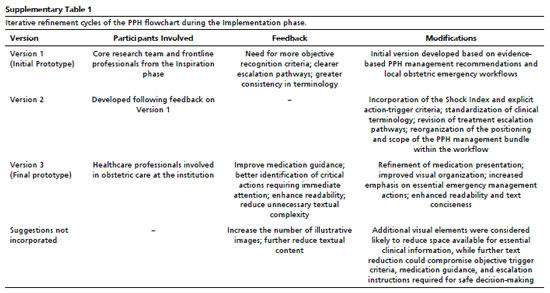
The initial prototype (Version 1) was reviewed by the core research team and frontline professionals who participated in the Inspiration phase. Feedback highlighted the need for more objective recognition criteria, clearer escalation pathways, and greater consistency in terminology. Based on these suggestions, Version 2 incorporated the Shock Index and explicit action-trigger criteria, standardized clinical terminology, and revised the treatment escalation sequence, including the positioning and scope of the PPH management bundle within the workflow. Not all recommendations were adopted. Specifically, recommendations to increase the number of illustrative images and further reduce textual content were not incorporated. The research team considered that additional visual elements would reduce the space available for essential clinical information, whereas further text reduction could compromise the inclusion of objective trigger criteria, medication guidance, and escalation instructions required for safe decision-making.
Version 2 was subsequently presented to healthcare professionals involved in obstetric care at the institution. Participants suggested improvements in the presentation of medication instructions, identification of critical actions requiring immediate attention, readability of the visual layout, and reduction of unnecessary textual complexity. These recommendations informed the development of Version 3, which incorporated refinements in content presentation, visual organization, text conciseness, and emphasis on essential emergency management actions.
The third version, entitled "Postpartum Hemorrhage Management: Essential Care Flowchart", reflects DT's iterative and user-centered development process and was considered the final prototype submitted for expert validation.
Validation of the Educational ProductFourteen professionals were invited to validate the instrument, of whom nine completed the evaluation questionnaire (response rate: 64.3%). The expert panel comprised six physicians (66.7%) and three obstetric nurses/midwives (33.3%), with a mean age of 46.7 years (SD=10.3 years) and mean professional experience 21.7 years (SD=7.6 years). Seven were faculty members with a mean teaching experience of 13 years (SD=3.6 years). Participants were recruited from different regions of Brazil, including the cities of São Paulo, Botucatu, Campinas, Recife, Belo Horizonte, and Florianópolis. None had participated in the Inspiration, Ideation, or initial development phases of the flowchart.
All items achieved the predefined content validity criterion, with item-level Content Validity Indexes (I-CVI) and Scale-level Content Validity Index (S-CVI/Ave) both reaching 1.00. Although all ratings fell within the adequate range (scores 3 or 4), variation was observed in the distribution of ratings between adequate and highly adequate categories. Four of nine experts rated the items "Guides the professional toward best clinical conduct" and "Clear and objective information" as partially adequate (44.4%), while three of nine rated "Legible and appropriate font" as partially adequate (33.3%). In contrast, items related to scientific evidence alignment, logical sequence, grammar, and image clarity achieved unanimous ratings of totally adequate.
Qualitative feedback guided the iterative refinement of the tool. Suggestions related to clinical clarity and precision included replacing the American English-based mnemonic with a Brazilian Portuguese equivalent to facilitate rapid cognitive recall, defining objective clinical criteria for "hemodynamic instability" to trigger bimanual massage, and specifying exact medication doses and routes of administration. Feedback on emergency suitability and conciseness emphasized the need to reduce textual density by using abbreviated, action-oriented language appropriate for high-stress reference. Regarding workflow emphasis, experts recommended explicitly highlighting the need to maintain bimanual uterine compression until bleeding improves and to escalate uterotonic agents within the first hour of management. Finally, suggestions for visual design and usability focused on improving font sizing and layout for optimal mobile device readability.
The flowchart presented in Figure 2 corresponds to the final version of the educational tool. Compared with the version evaluated during the content validation process, minor modifications were introduced after incorporating experts' suggestions and updating the content to improve clarity, terminology, visual organization, and consistency with current international recommendations. These changes did not affect the overall structure or educational purpose of the tool. The reported content-validity evidence pertains to the version evaluated by the expert panel, as subsequent modifications were not revalidated. These post-validation refinements primarily addressed the dimensions initially rated as partially adequate (clarity and clinical guidance).
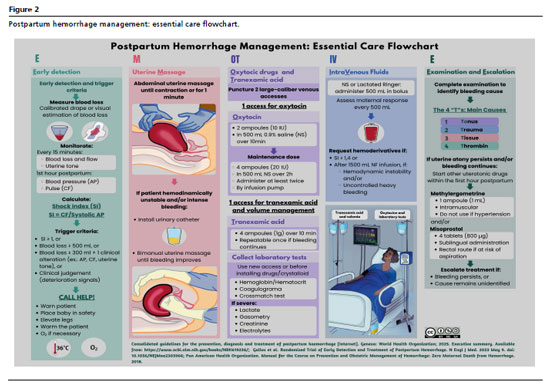
Among the post-validation refinements, the route of misoprostol administration was updated. The validated version recommended 800 μg by the rectal route, whereas the final published version included both sublingual and rectal routes. The sublingual route aligns the educational tool with the 2025 WHO/FIGO consolidated guideline, due to its faster onset.
4 The rectal route was retained as an alternative for unconscious or poorly responsive patients. Additionally, the escalation step was refined to include an explicit time frame, specifying that it should occur within the first hour postpartum and the numerical percentages detailing the prevalence of the causes of PPH were removed. These updates were implemented after expert validation and were not themselves revalidated.
Following content validation, the flowchart was displayed in a visible location within the OBED as a readily accessible point-of-care reference for PPH recognition and management. To facilitate dissemination and adaptation in different healthcare settings, the educational resource was released under a Creative Commons ShareAlike license, allowing redistribution and modification with appropriate attribution.
DiscussionDespite the availability of evidence-based recommendations and effective treatment bundles, postpartum hemorrhage remains a major cause of maternal mortality worldwide, highlighting the persistent gap between clinical knowledge and its implementation in routine practice.
1,13 DT has been reported as an effective approach for transforming the complex, multifaceted challenges of obstetric care into tangible, applicable solutions for clinical practice and health professions education.
14-16 In this study, DT served not only as a problem-solving strategy, but also as a participatory approach that fostered reflection on the human, organizational, and collaborative dimensions of obstetric care.
The developed flowchart represents more than a visual aid; it is a clinical design product that integrates scientific evidence with the needs and barriers identified during the Inspiration phase. Through a user-centered approach, DT helped bridge the gap between international evidence-based recommendations and the realities of local obstetric care, resulting in a context-adapted tool for PPH management based on the E-MOTIVE protocol.
13 This approach aligns with recent global recommendations emphasizing that a significant challenge in PPH management lies in overcoming resistance to change and ensuring context-appropriate implementation of treatment bundles.
1 The DT methodology enabled the systematic identification of challenges faced by healthcare teams in the PPH context, revealing issues consistent with previous studies and providing insight into the complex nature of obstetric emergencies.
1,17 As part of the immersive approach promoted by DT,
in situ simulations allowed direct observation of team interactions and workflow challenges within the clinical environment, generating context-sensitive insights that informed subsequent stages of the project.
Communication emerged as a central theme during the Inspiration phase. Effective information exchange, including closed-loop communication and interprofessional coordination, is essential for safe obstetric emergency care and may reduce both operational failures and adverse events.
18,19 Similarly, clearly defined roles and responsibilities facilitate timely and coordinated responses, whereas inadequate systematization may delay critical interventions.
17 Hierarchical barriers identified further reflect persistent challenges to interprofessional collaboration, as power dynamics can limit open communication and compromise patient safety.
20These findings are consistent with patient-safety frameworks that recognize communication failures, unclear role distribution, and hierarchical barriers as important contributors to adverse events.
1,17 Such barriers may directly affect the "Readiness" and "Recognition" phases of PPH management bundles, in which clear communication and objective triggers are essential to prevent cognitive overload.
1 Collectively, these results suggest that the challenges observed are not merely individual but are rooted in broader organizational and systemic factors.
The use of an effort-impact matrix enabled the strategic prioritization of proposed solutions, leading to the selection of a PPH care flowchart as the intervention with the best balance between potential impact and implementation feasibility. Although several promising interventions were identified, many required substantial structural, financial, or organizational changes, limiting their short-term applicability. In contrast, the flowchart directly addressed barriers identified during the Inspiration phase, including the absence of standardized protocols, communication challenges during emergencies, uncertainty regarding clinical responsibilities, and limited access to decision-support information at the point of care.
Flowcharts and checklists are recognized as effective tools for standardizing care processes, reducing errors, and improving team performance in high-risk clinical situations.
17,21 Literature suggests that visual resources may also reduce response times, reinforce protocol adherence, and support more objective and standardized clinical decision-making.
22,23The decision to base the educational product on the E-MOTIVE protocol strengthened its clinical relevance. In a multicenter study involving 80 hospitals in low- and middle-income countries, implementation of the E-MOTIVE strategy was associated with a 60% reduction in severe PPH, laparotomy, or maternal death.
13 Together, these findings reinforce the value of structured protocols combined with hands-on training to enhance action predictability and mitigate errors arising from practice variability.
24,25Several barriers identified are also supported by previous reports. Institutional problems that frequently affect working conditions include work overload, sudden team changes due to low professional retention within the institution, low adherence to institutional and care protocols, and difficulties with care handovers that compromise continuity of care and increase the risk of communication failures.
17,26 Although DT encourages creativity and innovation, the feasibility of implementing solutions may be limited by institutional, financial, and organizational constraints. Thus, the effectiveness of DT in healthcare depends not only on generating ideas, but also on the practical viability of implementing them within real clinical settings.
The collaborative DT approach enhanced team engagement and protocol acceptance while stimulating creative problem-solving. Expert validation of the flowchart achieved an I-CVI of 1.00 across all criteria, as all experts rated every item with scores of 3 (partially adequate) or 4 (totally adequate). However, the distribution of responses within this combined "adequate" category warrants closer examination. Items related to clinical guidance and visual clarity showed the greatest proportion of partial adequacy ratings (score 3), with nearly half of the evaluators (44.4%) assigning these lower scores. The dichotomization approach used in CVI calculation, which treats partial and total adequacy as equivalent for index purposes, may obscure clinically relevant gradations in expert opinion, particularly in small panels.
11 Consequently, while the tool met the predefined statistical thresholds for content validity, these nuances indicate that specific dimensions require further refinement before broader implementation. Future iterations should prioritize these areas through structured usability testing with end users from different professional backgrounds, extending the evaluation beyond content validity to encompass clarity, acceptability, and performance in real-world clinical settings.
Several limitations must be acknowledged. A limitation of this study is the participation rate in the validation stage. Non-response bias cannot be ruled out, as professionals who did not complete the evaluation may have held different perspectives on the content, usability, or applicability of the educational tool. The use of purposive sampling for expert selection may limit the representativeness of perspectives included in the validation process. There is also a potential risk of social desirability bias, as interviews were conducted by researchers affiliated with the same institution as participants.
Although nursing professionals constituted a substantial proportion of participants in the Inspiration phase, many were unable to attend the Ideation sessions due to clinical duties and scheduling constraints. Consequently, the Ideation group consisted primarily of OB-GYN residents, with one nurse and one physician participating. In addition, the participants took part in both the Inspiration and Ideation phases. Although such overlap is an intentional feature of DT and may strengthen engagement and facilitate implementation, it may also introduce confirmation bias, as individuals involved in identifying challenges may be more likely to prioritize and endorse solutions they helped generate. Nevertheless, the Ideation phase was grounded in findings from the Inspiration phase, which incorporated perspectives from a broader, predominantly nursing sample. Future studies could mitigate these limitations by incorporating external participants during solution prioritization or by including independent validation steps.
We acknowledge that, in its current format, the flowchart may not be fully optimized for real-time decision-making during an active PPH emergency, given its relatively dense textual content. This limitation is consistent with the item-level ratings, in which nearly half of the panel judged clarity and clinical guidance as only partially adequate, alongside qualitative suggestions to reduce textual density and to define objective thresholds for concepts such as hemodynamic instability. At present, the tool is used as a teaching resource during classes and simulation-based training, and is also made available within the OBED as a point-of-care guide during emergencies. A simplified, derivative version designed specifically for rapid bedside decision-making is currently under development. The proposed flowchart was not tested in real clinical scenarios; this study was limited to content validation, and further research is needed to assess its effectiveness, usability, acceptability among end-users, and impact on clinical outcomes in practice, including maternal mortality.
Future initiatives may include the development of an interactive continuing education website, periodic simulation-based training, digital decision-support tools, and structured communication protocols. By targeting the domains of communication, responsiveness of care, continuing education, protocol standardization, and organizational factors identified during the study, these strategies may enhance preparedness and facilitate the implementation of evidence-based PPH care.
Ultimately, this study highlights the potential of DT to bridge the gap between evidence-based guidelines and local clinical practice. Although the developed flowchart provides a structured, context-adapted reference with initial evidence of content validity, its actual impact on team performance and maternal outcomes requires further investigation. The transition from tool development to rigorous clinical implementation represents the next critical step in enhancing the safety and quality of care.
References1. Begum F, Nieto-Calvache AJ, Schlembach D, Hofmyer GJ, Palacios-Jaraquemada J, Bhardwaj A,
et al. FIGO recommendations on objective measurement of blood loss after birth for early detection of postpartum hemorrhage. Int J Gynaecol Obstet. 2025; 171 (3): 933-50. doi: 10.1002/ijgo.70523
2. World Health Organization (WHO). Trends in Maternal Mortality 2000 to 2020: Estimates by WHO, UNICEF, UNFPA, World Bank Group and UNDESA/Population Division. 1
a ed. Geneva: WHO; 2023. 108 p. [access in 2026 Feb 3]. Available from:
https://www.who.int/publications/i/item/97892400687593. Ministério da Saúde (BR). DATASUS. Tabnet. Brasília (DF): Ministério da Saúde; 2024. [access in 2025 Jul 22]. Available from:
https://tabnet.datasus.gov.br/cgi/tabcgi.exe?sim/cnv/mat10uf.def4. Consolidated guidelines for the prevention, diagnosis and treatment of postpartum haemorrhage [
Internet]. Geneva: World Health Organization; 2025. Executive summary. Available from:
https://www.ncbi.nlm.nih.gov/books/NBK619236/5. Fransen AF, van de Ven J, Banga FR, Mol BWJ, Oei SG. Multi-professional simulation-based team training in obstetric emergencies for improving patient outcomes and trainees' performance. Cochrane Database Syst Rev. 2020 Dec; 12 (12): CD011545. doi: 10.1002/14651858.CD011545.pub2
6. Lyon AR, Aung T, Bruzios KE, Munson S. Human-Centered Design to Enhance Implementation and Impact in Health. Annu Rev Public Health. 2025 Apr; 46 (1): 467-85. doi: 10.1146/annurev-publhealth-071823-122337
7. Brown T. Design Thinking. Harv Bus Rev. 2008; 86 (6): 84-92.
8. Guest G, Bunce A, Johnson L. How many interviews are enough?: an experiment with data saturation and variability. Field Methods. 2006; 18 (1): 59-82.
https://doi.org/10.1177/1525822X052799039. Bardin L. Content Analysis. Lisboa: Almedina; 2011. 280 p.
10. Lynn MR. Determination and quantification of content validity. Nurs Res. 1986; 35 (6): 382-5.
11. Polit DF, Beck CT. The content validity index: are you sure you know what's being reported? Critique and recommendations. Res Nurs Health. 2006 Oct; 29 (5):489-97. doi: 10.1002/nur.20147
12. Forbes G, Akter S, Miller S, Galadanci H, Qureshi Z, Fawcus S,
et al. Factors influencing postpartum haemorrhage detection and management and the implementation of a new postpartum haemorrhage care bundle (E-MOTIVE) in Kenya, Nigeria, and South Africa. Implement Sci. 2023 Jan; 18 (1): 1. doi: 10.1186/s13012-022-01253-0
13. Gallos I, Devall A, Martin J, Middleton L, Beeson L, Galadanci H,
et al. Randomized trial of early detection and treatment of postpartum hemorrhage. N Engl J Med. 2023 Jul; 389 (1): 11-21. doi: 10.1056/NEJMoa2303966
14. Lorusso LL, Lee JH, Worden EA. Design thinking for healthcare: transliterating the creative problem-solving method into architectural practice. Health Environ Res Des. 2021; 14 (2): 16-29. doi: 10.1177/1937586721994228
15. Del-Valle Quintana L, Sichieri K, Secoli S. Design Thinking and its use to promote patient safety: A scoping review. J Healthc Qual Res. 2025 May; 40 (4): 101140. [Spanish] doi: 10.1016/j.jhqr.2025.101140
16. Romero V, Donaldson H. Human-centred design thinking and public health education: A scoping review. Health Promot J Austr. 2024 Jul; 35 (3): 688-700. doi: 10.1002/hpja.802
17. Gleeson LL, O'Brien GL, O'Mahony D, Byrne S. Interprofessional communication in the hospital setting : a systematic review of the qualitative literature. J Interprof Care. 2023; 37 (2): 203-13. doi: 10.1080/13561820.2022.2028746
18. Brito MA, Carneiro CT, Bezerra MA, Rocha RC, Rocha SS. Estratégias de comunicação efetiva entre profissionais de saúde em neonatologia: revisão integrativa. Enferm Glob. 2022 Jul; 67: 564-77.
https://doi.org/10.6018/eglobal.50205119. Pena MM, Melleiro MM. Eventos adversos decorrentes de falhas de comunicação: reflexões sobre um modelo para transição do cuidado. Rev Enferm UFSM. 2018 Sep; 8 (3): 616-25.
https://doi.org/10.5902/217976922543220. Pradelli L, Risoli C, Summer E, Bellini G, Mozzarelli F, Anderson G,
et al. Healthcare professional perspective on barriers and facilitators of multidisciplinary team working in acute care setting: a systematic review and meta-synthesis. BMJ Open. 2025 Mar; 15 (3): e087268. doi: 10.1136/bmjopen-2024-087268.
21. Kost M, Hewitt M, Betron C, O'Donnell JM. An in-situ interprofessional simulation program to improve teamwork and obstetric crisis management skills. J Interprofessional Educ Pract. 2019 Sep; 16: 100264. doi: 10.1016/j.xjep.2019.100264
22. Dingley C, Daugherty K, Derieg MK, Persing R. Improving Patient Safety Through Provider Communication Strategy Enhancements. In: Henriksen K, Battles JB, Keyes MA, Grady ML, editors. Advances in Patient Safety: New Directions and Alternative Approaches (Vol 3: Performance and Tools). Rockville (MD): Agency for Healthcare Research and Quality (US); 2008. [access in 2026 Feb 3]. Available from:
https://pubmed.ncbi.nlm.nih.gov/21249923/23. Greig PR, Zolger D, Onwochei DN, Thurley N, Higham H, Desai N. Cognitive aids in the management of clinical emergencies: a systematic review. Anaesthesia. 2023 Mar; 78 (3): 343-55. doi: 10.1111/anae.15939
24. Coelho TS, Nour GFA, Maciel NS, Rodrigues VCC, Carneiro JL, Freitas MML,
et al. Effectiveness of clinical simulation for training postpartum hemorrhage management: a systematic review. Texto Contexto Enferm. 2026;35: e20250001. doi:10.1590/1980-265X-TCE-2025-0001en.
25. Federspiel JJ, Eke AC, Eppes CS. Postpartum hemorrhage protocols and benchmarks: improving care through standardization. Am J Obstet Gynecol MFM. 2023 Feb; 5 (2S): 100740. doi: 10.1016/j.ajogmf.2022.100740.
26. Bautista-Valarezo E, Espinosa ME, Michels NR, Hendrickx K, Verhoeven V. Culturally adapted flowcharts in obstetric emergencies: a participatory action research study. BMC Pregnancy Childbirth. 2022 Oct; 22 (1): 772. doi: 10.1186/s12884-022-05105-z.
AcknowledgmentsThis study received no external funding for data collection. The first author was supported by a scientific initiation scholarship from the
Conselho Nacional de Desenvolvimento Científico e Tecnológico (CNPq), Brazil. No other authors received financial support for this work.
Use of artificial intelligenceIn accordance with current recommendations for transparency in scholarly publishing, the authors declare that a generative artificial intelligence tool, Claude (Anthropic, San Francisco, CA, USA), was used during the preparation of this manuscript as an editorial assistance tool. Its use was restricted to the following purposes: correction of spelling, grammar, and syntax errors; improvement of fluency and clarity of academic English prose.
The AI tool was not involved in any of the following: study design or conceptualization; data collection, extraction, or management; execution of any analyses; literature search or selection of references; formulation of scientific conclusions; or any component of the intellectual content of the manuscript. All intellectual content, scientific analyses, interpretation of findings, and conclusions presented in this manuscript are entirely the work of the human authors and remain their sole responsibility. The final version of the manuscript was reviewed and approved by all authors prior to submission. Consistent with current guidance from the International Committee of Medical Journal Editors (ICMJE) and the Committee on Publication Ethics (COPE), the AI tool is not listed as an author, as authorship requires accountability that cannot be attributed to a software tool.
Authors' contributionsMengarda LG: Conceptualization (Equal), Formal analysis (Lead), Investigation (Lead), Supervision (Lead), Validation (Equal), Visualization (Equal), Writing - original draft (Lead), Writing - review & editing (Lead).
Caixeta JV and Sales M: Conceptualization (Equal), Formal analysis (Equal), Methodology (Equal).
Reinaldo JZ and Carnevalli SVB: Data curation (Equal), Investigation (Equal),Writing - original draft (Supporting).
Knobel R: Conceptualization (Lead), Data curation (Lead), Methodology (Lead), Funding acquisition (Lead), Supervision (Equal), Writing - original draft (Equal), Writing - review & editing (Equal).
All authors approved the final version of the article and declare there are no conflicts of interest.
Data availabilitySummary data supporting the findings of this study are presented within the article. Raw qualitative data (interview and focus group transcripts) are not publicly available, as the limited number of participants and the single-institution setting could compromise participant confidentiality and anonymity. Supplementary materials, including the interview guide and the validation questionnaire, are available from the corresponding author upon reasonable request.
Received on June 8, 2026
Final version presented on July 28, 2026
Approved on July 29, 2026
Associated Editor: Melania Amorim


 ; Juliana Vieira Caixeta2








 Ler em português
 Download PDF
 Imprimir
 Enviar este artigo por email
 Como citar este artigo
 Enviar um comentário
 Mendeley
 Pocket
 Compartilhar no Facebook
 Compartilhar no Twitter